
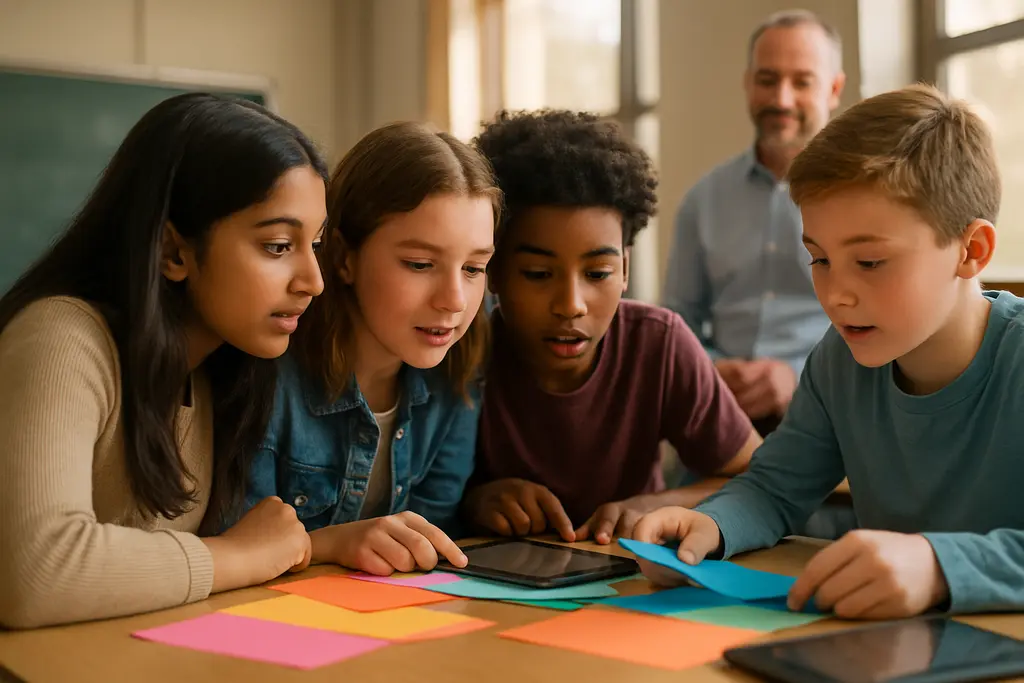
On September 2, 2026, New York City announced a one-year AI School Pause for student-facing generative AI tools in grades 2-K through 8 for the 2026-27 school year. The city said the moratorium affects about 600,000 students, or roughly two-thirds of public school enrollment, while high school use is limited to vetted pilots, career-readiness contexts, and AI-literacy instruction, according to the NYC Mayor’s Office announcement.
Los Angeles Unified School District took a similar K-8 approach during the same week, as described in the supplied research record, with restrictions on generative AI access on district-issued student devices while the district reviewed instructional use and safeguards. Because the permitted source set for this article includes official New York materials but not an LAUSD policy page, the Los Angeles discussion here is treated more cautiously and focuses on the shared policy questions raised by the two districts.
For inclusive curriculum development, the issue is not whether schools should accept or reject every AI tool. The sharper question is whether a pause can protect younger students from poorly governed technology while still preserving equitable access to digital literacy, teacher-guided inquiry, and community voice. That balance matters because student engagement is not only screen participation. It includes discussion, sustained attention, cultural relevance, peer collaboration, and a student’s sense that classroom work has meaning.
Why The AI School Pause Is A Curriculum Question
AI School Pause And Student Engagement
The AI School Pause should be read as a curriculum decision, not only a technology restriction. In New York City, the pause was paired with screen-time limits for younger grades: no one-to-one screen time in grades 2-K, a recommended maximum of 30 minutes per day in grades 3-5, and a maximum of 45 minutes per day in grades 6-8, according to the city’s AI and screen-time guidance. Those limits signal a belief that human interaction, hands-on learning, and teacher-led instruction remain central for younger learners.
That position is consistent with concerns described in the research notes: cognitive development, overreliance on automated responses, reduced human interaction, student well-being, data privacy, and academic integrity. Still, evidence on the immediate effects of AI restrictions on engagement remains limited. A district may reduce screen exposure without automatically improving participation, curiosity, or belonging. Engagement depends on what replaces the tool.
For example, a classroom that removes generative AI but leaves students with repetitive worksheets may not produce stronger engagement. A classroom that replaces AI prompts with collaborative reading, discussion, writing conferences, civic problem-solving, arts integration, and culturally responsive examples has a stronger case for improving participation. The policy action creates an opening; it does not by itself guarantee better curriculum.
What Counts As Engagement
Districts also need to define engagement with care. Login time, assignment completion, and device activity can be easy to measure, but they may miss deeper learning. Inclusive curriculum asks whether students from different language backgrounds, disability communities, racial and ethnic groups, income levels, and family circumstances have meaningful access to the work.
A cautious engagement review should examine several forms of evidence:
- Student participation in discussion, writing, projects, and peer collaboration.
- Teacher observations about attention, persistence, and classroom interaction.
- Family and community feedback, especially from groups often left out of technology decisions.
- Access to AI literacy for older students and age-appropriate digital citizenship for younger students.
- Privacy safeguards, including what data tools collect and who can review it.
These indicators do not require districts to ignore test scores or platform data. They ask districts to avoid treating digital traces as the whole story. That distinction is particularly important for students who may be highly engaged orally, creatively, or collaboratively but less visible in automated systems.
Equity Risks In A Broad Moratorium
Access Can Shift Outside School
A broad moratorium may protect students during school hours, but it can also shift AI access to homes, phones, libraries, and private tutoring. Families with paid subscriptions, newer devices, or adults who understand AI tools may continue building skills outside school. Students without those supports may receive less guided exposure. That is where equity concerns become more than theoretical.
New York’s high school exception shows one way to reduce that risk for older students: use approved pilots, career-readiness programs, and AI-literacy modules rather than open access. But younger students still need developmentally appropriate preparation for a world in which AI-generated content exists. That does not require letting second graders use chatbots. It can mean teaching source evaluation, authorship, questioning, bias recognition, and respectful technology habits through teacher-led activities.
LAUSD’s reported device-level restrictions raise a related issue. Blocking generative AI on district-issued devices may be enforceable within school systems, but students with personal devices may experience different access conditions. Schools should avoid punishing students for unequal access and should avoid assuming that blocked access equals equal opportunity.
Community Involvement Should Shape The Replacement Plan
As Naomi Baxter’s equity-centered approach to curriculum would suggest, the pause should not be designed only by central offices and vendors. Families, students, educators, disability advocates, multilingual communities, and local organizations need a direct role in deciding what learning experiences replace student-facing AI.
That community role is practical. Parents may notice changes in homework stress or independent reading. Teachers may see whether discussion improves or whether students become less confident without automated help. Students can explain whether work feels more meaningful or simply more restrictive. Community groups can help districts see access gaps that are not visible in procurement documents.
The Parative Project has examined the related NYC AI ban rationale, including concerns about privacy, screen time, and equity. Readers following public-policy effects across communities can also find related network coverage at Earth Times, a site featuring articles about global and environmental news.
What Districts Should Measure During 2026-27

Because the moratoria were adopted for the 2026-27 school year, districts have a defined period in which to gather evidence. The most useful public reporting would not simply state whether AI tools were blocked. It would explain whether the replacement instructional practices improved or harmed student engagement, and for whom.
Districts could report grade-band differences, but they should avoid publishing sensitive student data or creating new surveillance burdens. Aggregated evidence, teacher surveys, family listening sessions, classroom observations, and student feedback can offer a clearer picture than platform analytics alone. Any review should separate several questions that are often blended together:
- Did reduced screen time change classroom interaction?
- Did students produce more original writing, discussion, or project work?
- Did teachers receive enough planning time and professional learning?
- Did multilingual learners and students with disabilities keep access to needed supports?
- Did older students receive responsible AI instruction rather than only restrictions?
This approach would help prevent a false choice between safety and opportunity. Students deserve protection from poorly tested tools, but they also deserve a curriculum that prepares them to understand technologies shaping workplaces, media, and civic life. The challenge is to match access to age, purpose, privacy protections, and instructional need.
What The AI School Pause Means For Inclusive Curriculum
The AI School Pause in New York City and the similar Los Angeles action should be evaluated by evidence, not slogans. As of October 5, 2026, the clearest confirmed New York facts are the one-year K-8 moratorium, the approximate number of affected students, the limited high school exceptions, and the screen-time limits by grade band. The engagement effects remain uncertain.
That uncertainty is not a weakness if districts use it honestly. A pause can create time to examine privacy, developmental concerns, academic integrity, teacher workload, and access. It can also create risk if it becomes a blanket substitute for AI literacy or if students with more resources keep learning the tools outside school while others do not.
An inclusive curriculum response would treat the moratorium as a temporary governance step. It would invest in human-centered teaching, community feedback, age-appropriate digital literacy, and transparent public reporting. The fairest test is whether students experience more meaningful learning, stronger relationships, safer data practices, and better access to future-ready knowledge during and after the pause.