
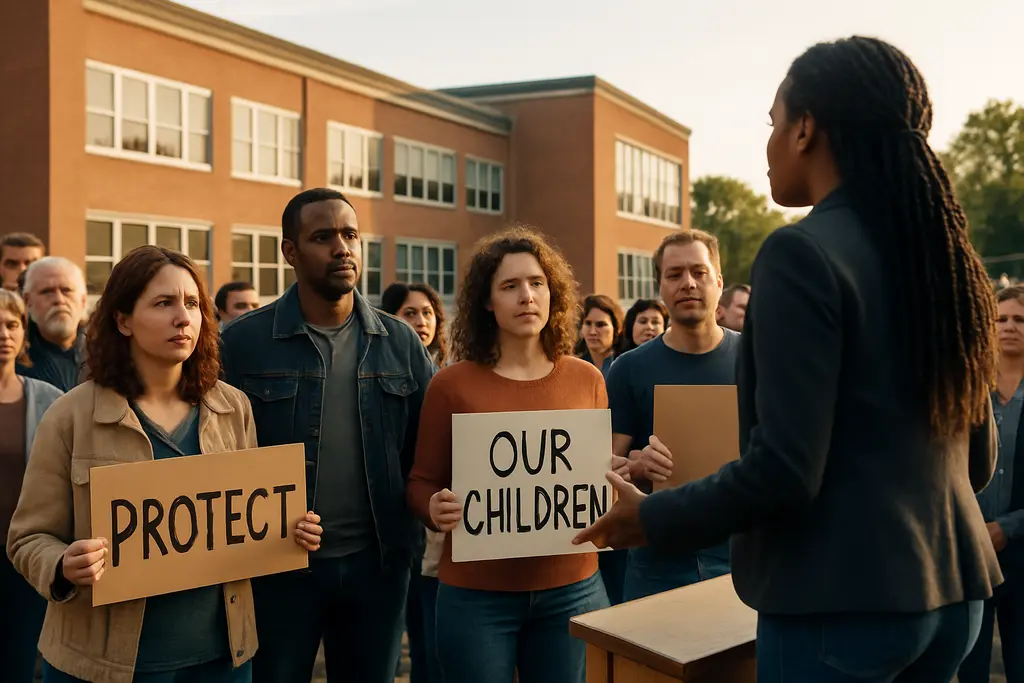
Updated school gender policies have moved from board agendas into courts, federal offices, parent meetings, and staff training sessions. The community response is not one single movement; it includes parents seeking access to records, students and advocates raising privacy concerns, districts revising guidance, and state-level rules that vary by jurisdiction.
Because the research record provided for this article contains official actions, litigation updates, policy reports, and public survey data rather than direct first-person survivor accounts, this analysis does not present individual survivor narratives. That limit matters. Personal accounts can show how policies affect daily life, but they require careful sourcing, consent, and context. The available record instead supports a narrower review of how public institutions and communities have responded.
How School Gender Policies Prompt Local Responses
Community Action Through Complaints And Hearings
Community responses described in the 2026 research record took several formal routes. Parents and advocacy groups filed complaints, districts revised written guidance, superintendents defended policies before Congress, and school boards faced pressure over whether staff should notify parents when a student asks to use a different name, pronouns, or facilities at school. These are institutional responses, not merely cultural reactions.
The federal action involving Kansas illustrates why the debate often turns on records access rather than public slogans. On April 17, 2026, the U.S. Department of Education’s Student Privacy Policy Office found that Kansas City Kansas, Olathe, Shawnee Mission, and Topeka school districts violated FERPA and Title IX in connection with policies that prevented parent notification or access to records after parents requested information about their children, according to the department’s Education Department findings.
School Gender Policies And Parent Records
The Kansas findings show how school gender policies can become a records-governance issue. FERPA is centered on access to education records, not on every informal conversation between a student and a staff member. Still, once a school creates or maintains a record directly related to a student, families and districts need clarity about where that record is stored, who can see it, and how a parent request is handled.
That distinction is practical for local communities. Parents may frame the issue as notice and authority. Students and supportive adults may frame it as safety and privacy. District leaders have to translate those concerns into written procedures that employees can follow without improvising case by case. If records exist in separate systems, informal files, counselor notes, or electronic platforms, the risk of inconsistent handling increases.
What The 2026 Policy Record Shows
Court Rulings Did Not Resolve Every Question
The 2026 research record points to several court-related developments that shaped local expectations. On January 5, 2026, a federal court ruling involving Escondido Union School District and the California State Board of Education upheld teachers’ rights to inform parents about a child’s gender identity at school, while the state appealed. On September 15, 2026, a San Bernardino County judge ruled that California schools could not automatically disclose a student’s gender identity to parents, but must do so when parents ask. The same ruling struck down part of Chino Valley Unified School District’s policy requiring automatic notification if students requested names, pronouns, or facilities not aligned with birth sex.
Those rulings, as described in the research notes, pulled communities toward a more conditional approach: automatic disclosure was treated differently from disclosure after a parent inquiry. For families and school staff, the difference is more than technical. It affects how front offices respond to a records request, how principals train employees, and how districts communicate policy changes without overstating what courts have decided.
State Rules Added Local Variation
State legislation has added another layer. A January 2026 Williams Institute report reviewing 2025 state anti-transgender legislation identified state measures requiring parental notification when a student asserts a gender identity inconsistent with birth sex or requests different pronouns. The report cited Florida’s law requiring notification of changes to a child’s “sexual wellbeing,” including gender identity, and South Carolina’s written-notification requirement when a student asserts a gender identity inconsistent with sex, according to the Williams Institute report.
The research also identified variation in North Carolina after the state’s 2023 Parents’ Bill of Rights. A March 2026 report found that districts and staff implemented name and pronoun notification rules differently, with some notifying parents in all cases, some doing so only for gender-nonconforming students, and some refraining because of student safety concerns. That variation helps explain why community meetings often focus on the same recurring question: what exactly does the local policy require on Monday morning in a school building?
Community Trust Depends On Clear Records

What Families Can Ask Without Escalating
For families, the most constructive first step is often a precise request rather than a broad accusation. A parent can ask what written records exist, which district policy governs access, whether the district has a standard response timeline, and who is responsible for reviewing the request. That approach does not settle the values dispute, but it helps establish a verifiable record of what the school has done.
Related policy disputes have raised similar questions about parent notice, student privacy, and district obligations; The Parative Project’s review of a California disclosure ruling examined the distinction between automatic alerts and responses to direct parent inquiries. That distinction is likely to remain central in communities that are trying to reconcile privacy concerns with parent-access rules.
What Districts Can Clarify In Public
Districts can reduce confusion by publishing plain-language answers to a few recurring questions:
- Which student records are covered by parent-access procedures?
- Who decides whether a safety concern affects disclosure or timing?
- How are staff trained to respond when a student asks for privacy?
- What process does a parent use to request records or policy clarification?
Public explanations should avoid promises that staff cannot keep. If a district tells students that some information is confidential, the district should also explain any legal limits on that confidentiality. If a district tells parents that they may inspect records, it should identify the process and any limits. Community groups, local newsrooms, and related education sites such as education policy coverage can help residents compare public claims with official documents, but the district remains responsible for its own policy language.
School Gender Policies In Community Practice
The community response to school gender policies in 2026 showed how quickly a student-support procedure can become a public-governance dispute. Some families saw nondisclosure rules as an exclusion from decisions involving their children. Some students and advocates viewed automatic notice as a risk to privacy or safety. Some district leaders argued that they were trying to comply with state law, federal obligations, and community expectations at the same time.
The supported record does not justify a single national claim about what every community wants. It does show that courts, federal officials, school boards, and families are pressing districts to define their procedures more clearly. The strongest local policies will likely be the ones that state what is enacted, what is only proposed, what is required by law, what remains disputed, and how records requests are handled in practice.
For communities, the next useful discussion is not whether concern on one side cancels concern on the other. It is whether schools can identify the records they keep, explain how parents may access them, protect students from unnecessary exposure, and train staff to follow the same process across classrooms, counseling offices, and administrative systems. That is where abstract policy becomes daily school practice.