

The technology debate in Lower Merion School District has become a policy test for how affluent, high-performing districts respond when families say classroom screens have moved from helpful tools to daily saturation. In May and June 2026, parents, students, educators, and board members clashed over whether students should have a meaningful way to opt out of district-issued devices, whether younger children need routine classroom screens, and how much control families should have over digital learning platforms used during the school day.
The dispute is not a simple fight between technology and paper. Lower Merion’s own June 2026 update says the district is moving toward grade-band limits, stronger filtering, parent monitoring tools, and a new technology-use policy after public pressure. That matters for education equity. Screen access once stood at the center of digital equity policy. The new backlash asks a different question: who gets protected from overuse, distraction, weak instructional design, and unclear accountability when screens become the default classroom infrastructure?
Why Lower Merion Became A National EdTech Flashpoint
Lower Merion School District serves students in Lower Merion Township and Narberth, outside Philadelphia, and has long presented technology as part of its instructional identity. The district’s instructional technology page describes a system that evolved from single classroom computer workstations into an integrated teaching and learning environment, with laptops, tablets, interactive whiteboards, online subscriptions, and course-specific software available to students.

That institutional history helps explain why parent concerns became so intense. The local debate did not begin in a district without devices. It began in a district where technology was already woven into classroom routines, homework submission, learning apps, student communications, and digital citizenship work. Families objecting to screen saturation were challenging a deeply embedded system, not a small classroom experiment.
The issue became visible nationally after Associated Press reporting, republished by WHYY, described parents across the country pressing schools to return more instruction to pencils, paper, books, and direct teacher interaction. In Lower Merion, more than 600 people signed a petition seeking to preserve parents’ ability to opt children out of digital devices during the school day, and more than 100 people attended a board meeting where many wore “Screens Down, Pencils Up” buttons. The district response, reflected in public reporting, was that broad opt-outs were not feasible when technology had become central to the curriculum through WHYY’s Lower Merion reporting.
The backlash reveals a governance gap. Districts can no longer defend edtech only by saying students need digital skills. Parents are asking which apps are used, what each program teaches better than a non-digital method, how many minutes students spend on screens by grade, what data vendors collect, how distractions are blocked, and what alternatives exist when screen use conflicts with a child’s learning needs.
What The June 2026 Policy Shift Shows
Lower Merion’s June 2026 update shows the district has already moved from defending the old model toward revising it. Superintendent Dr. Frank Ranelli wrote that on June 15, 2026, the Lower Merion Board of School Directors approved a First Reading of a new Technology Use Policy. He said the policy was not final, but would guide planning for the 2026-2027 school year.
The proposed framework marks a major shift from device ubiquity toward grade-band differentiation. The district said technology should be used only when it serves a clear educational purpose and supports teaching and learning. It said technology should not replace non-digital methods or essential learning experiences. The update said K-2 students would have no individual devices and no routine classroom technology use; grades 3-4 would have no individual devices and limited supervised classroom use; grades 5-6 would receive individual devices for classroom use under teacher supervision, with parents able to choose whether devices go home; grades 7-12 would receive devices for use in and out of school through the LMSD technology update.
That policy direction matters more than the local vote count. It shows that the district accepted at least part of the parent critique: age, purpose, supervision, and home access should shape technology use. The central conflict remains whether families should have a formal opt-out right from one-to-one devices or whether district leaders can manage concerns through system-wide rules.
Local television coverage reported that the Lower Merion School Board voted on June 15 to repeal the current technology policy and move toward a new one. 6abc reported that the proposal would remove technology from routine K-2 classroom instruction, delay individual devices until fifth grade, and postpone required take-home devices until seventh grade through 6abc’s school board coverage.
For policy leaders, the lesson is clear: device programs need periodic review just like curriculum, staffing, discipline, and assessment policies. If a district can audit textbooks, it can audit learning apps. If a district can evaluate classroom time, it can evaluate screen time. If a district can require digital citizenship lessons, it can report whether device use strengthens or weakens student attention, writing, numeracy, reading, collaboration, and teacher-student relationships.
Screen Saturation Is An Equity Issue, Not Just A Parenting Preference
The Lower Merion dispute sits inside a larger national turn against automatic edtech expansion. After pandemic-era remote learning, many school systems kept one-to-one devices, digital platforms, online assignments, and app-based practice programs as ordinary classroom infrastructure. Access gaps did matter, and they still do. Students without broadband, devices, assistive technology, or digital literacy can face real barriers. The Parative Project has covered that problem in broader digital divide barriers analysis.

The new equity question is more complicated. Equal device access does not guarantee equal learning conditions. A student who struggles with attention, anxiety, reading stamina, visual strain, handwriting, or executive function may experience screen-heavy instruction very differently from a student who benefits from online practice. A family that tightly limits recreational screens at home may feel undermined if school-issued devices become a back door to YouTube, games, messaging, or fast-click learning platforms.
Federal health data gives parent concerns more policy weight, though it does not prove that every school device causes harm. A CDC National Center for Health Statistics data brief published in October 2024 found that, from July 2021 through December 2023, teenagers ages 12-17 with four or more hours of daily screen time were more likely to report recent anxiety or depression symptoms than teenagers with less than four hours. The CDC reported anxiety symptoms among 27.1% of teenagers with four or more daily screen hours, compared with 12.3% for those below that threshold; depression symptoms were 25.9% compared with 9.5% through the CDC screen time data brief.
That data should be used carefully. It concerns daily screen time across contexts, not only schoolwork, and it shows association rather than a single cause. Yet it strengthens the case for districts to measure exposure, separate instructional use from recreational drift, and avoid treating every digital minute as academically neutral.
The equity frame should include students who need technology for disability accommodations, language access, specialized learning supports, or assistive communication. Lower Merion’s June update recognized that technology resources would continue to support specialized educational plans, accommodations, modifications, and other services that promote inclusion and equitable access. The policy task is not to remove needed tools. It is to stop confusing targeted supports with universal saturation.
Parent Protests Are Forcing A New Accountability Model
The Lower Merion protests show how edtech accountability now belongs in public governance. Pencils Over Pixels, a grassroots parent, educator, and community group, says it supports intentional and responsible technology use but worries students have become dependent on screens and apps. Its demands include public release of vendor contracts, privacy agreements, aggregate screen-use data by grade and school, stronger content filtering, teacher-led core instruction, and opt-in consent for devices and apps.
Advocacy pages should not be treated as neutral research. Still, they identify questions district leaders must be ready to answer. Which vendors collect student data? Which apps are required? How much of the school day is screen-based by grade band? Which websites are blocked? How often do teachers override blocks for instructional use? Which non-digital alternatives are available? Who decides whether a program is improving learning?
Lower Merion’s own response shows movement toward that accountability model. The district said it is providing teachers real-time control and oversight of student technology use, introducing an app for parents and guardians to monitor daily district technology use, providing a tool to restrict district device functionality at home for grades 5-12, strengthening web filters, creating a reporting method for families to flag websites, and developing alternative instruction options for elementary students during emergency school closures.
The American Academy of Pediatrics’ 2026 policy statement on digital ecosystems offers a useful way to frame the issue. The AAP says digital media can support learning and well-being when designed around children’s developmental needs, but digital environments that prioritize engagement and commercialization can encourage prolonged use and displace sleep, movement, and other healthy behaviors through the AAP digital ecosystems policy.
That distinction belongs in every district technology policy. The question is not whether an app is modern. The question is whether it serves a clear learning purpose, respects child development, protects privacy, limits distraction, and gives teachers stronger instructional control rather than extra monitoring burdens.
What Districts Should Learn Before The Next Device Vote
Lower Merion is a local case with national implications. Districts that expanded one-to-one devices during or after the pandemic now face a different accountability climate. Parents are less willing to accept broad assurances that technology prepares students for the future. They want evidence, limits, transparency, and a stronger role for teacher-led instruction.
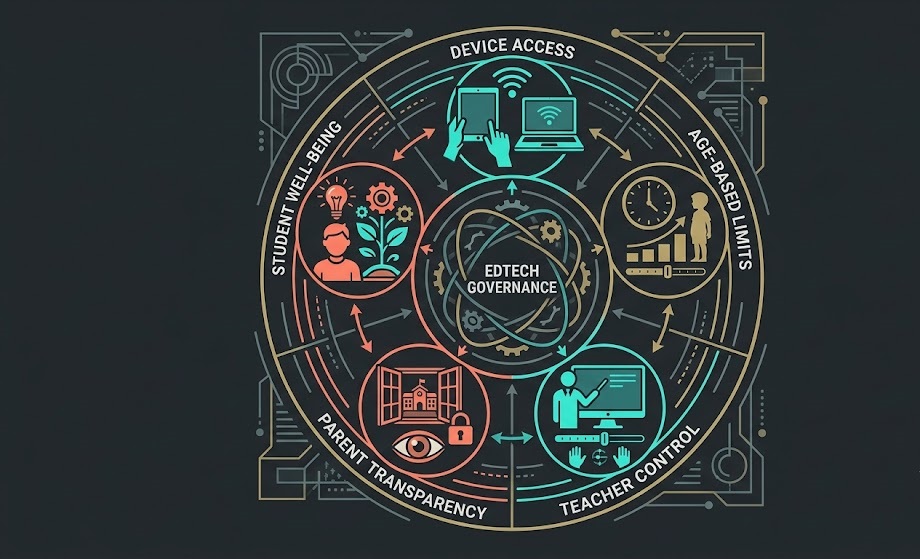
A better district policy would begin with a screen-use inventory. Leaders should publish device use by grade band, purpose, platform category, and setting. They should distinguish creation, research, accessibility, assessment, practice software, communication, entertainment leakage, and administrative convenience. That inventory would let the community argue over facts rather than anecdotes.
A second step is vendor accountability. Districts should maintain a public list of required apps, explain what data each vendor collects, identify the legal basis for use, and state whether families have alternatives. For younger students, districts should justify any routine digital use against developmental goals such as handwriting, reading fluency, social language, play, and teacher interaction.
A third step is teacher-centered implementation. Educators need authority to shut screens, redirect students to books and paper, block distracting sites, and choose non-digital methods when they fit the lesson. If teachers spend too much class time policing screens, the technology has shifted labor away from instruction and toward surveillance.
The fourth step is family recourse. Full opt-outs may be operationally hard in one-to-one districts, but that does not erase the need for formal review pathways. Districts can create accommodation processes, grade-specific alternatives, home-use restrictions, app-level exemptions, and regular public reporting without treating every parent concern as a threat to modernization.
Lower Merion’s June 2026 policy debate shows that edtech legitimacy now depends on proof of educational value. The districts that adapt fastest will not be the ones that reject technology. They will be the ones that place screens back inside a disciplined instructional system: clear purpose, age-sensitive use, privacy safeguards, teacher authority, public data, and credible alternatives when students need them.