
Los Angeles Unified School District’s new screen-time policy turns a parent-led education concern into a national test of district accountability. On June 23, 2026, the LAUSD Board of Education unanimously approved grade-level limits on student screen use, following an April resolution led by Board Member Nick Melvoin and co-sponsored by Karla Griego, Tanya Ortiz Franklin, Kelly Gonez, Board Vice President Rocío Rivas, and Student Board Member Jerry Yang. The policy follows LAUSD’s earlier cellphone restrictions and places the nation’s second-largest school district at the center of a fast-moving debate over whether fewer classroom screens can improve learning.
The district’s scale makes the experiment hard to ignore. LAUSD says it enrolls more than 520,000 students and covers 710 square miles, including most of Los Angeles and all or portions of 25 cities and unincorporated areas of Los Angeles County. If device reduction works in a system that large, other districts will have a concrete model. If implementation stalls, it will show why screen-time reform needs more than a board vote.
Why LAUSD’s Screen-Time Limits Matter Nationally
LAUSD’s policy arrives after years of school technology expansion. During the COVID-19 pandemic, devices and online platforms became necessary infrastructure. Districts distributed Chromebooks, expanded Wi-Fi access, adopted learning apps, and trained teachers to keep instruction moving when classrooms were disrupted. The equity argument was real: students without devices and internet access were at a disadvantage.
Now districts are facing the second half of that equity question. Access alone does not prove educational value. A student can have a device and still receive weaker instruction if digital time displaces reading, writing, discussion, hands-on work, teacher feedback, play, or social learning. LAUSD’s move reflects that shift from device access to device accountability.
The official LAUSD announcement in April described the resolution as a way to create “developmentally appropriate guardrails” on instructional technology, eliminate student device use for the youngest learners, prohibit student-led use of YouTube and other streaming platforms, and review classroom technology contracts through the district’s screen-time resolution. Acting Superintendent Andrés E. Chait said technology can expand access and support learning, but is most effective when used purposefully and guided by educators.
That framing puts LAUSD in the same policy sequence as The Parative Project’s recent FCC E-Rate screen-time accountability coverage. Federal policymakers are asking whether school broadband subsidies should support stronger digital guardrails, while local districts are asking how much screen exposure belongs inside the school day. LAUSD is where that federal-local question becomes classroom practice.
What The New Limits Actually Do
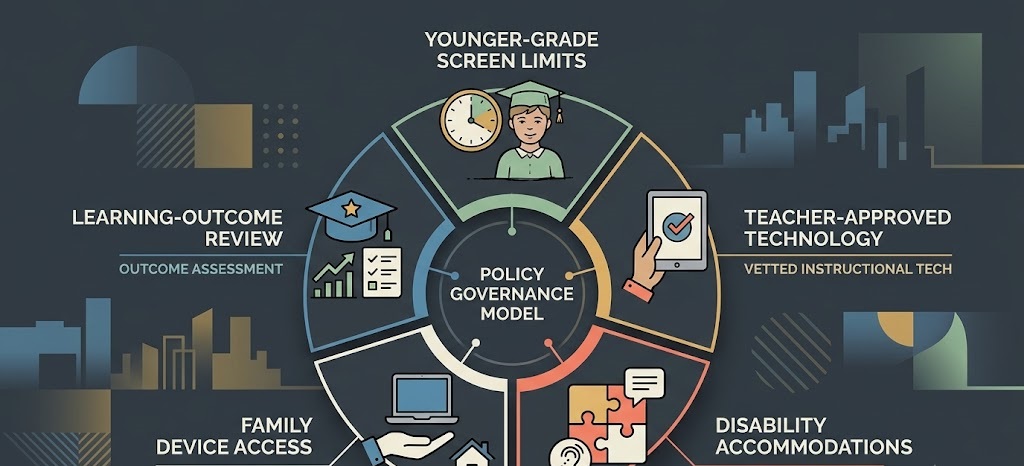
The approved LAUSD policy sets different limits by age group. Recent reporting says early education, kindergarten, and first grade students will have no screen time during the school day. Students in grades two and three will be limited to 20 minutes per day, or 100 minutes per week, including homework. Grades four and five will be limited to 30 minutes per day, or 150 minutes per week. Grades six through eight will be limited to 60 minutes per subject per week, and grades nine through 12 will be limited to 90 minutes per subject per week, with homework included.

The policy is scheduled for phased implementation. ABC News reported that the youngest students begin in August 2026, grades two through five begin in November 2026, and grades six through 12 begin in January 2027 through its LAUSD screen-time report.
K-12 Dive reported that the policy also moves elementary schools toward laptop carts or computer labs instead of one-to-one device use for grades two through five, and gives families the ability to opt into using district-issued devices at home. The same report said elementary and middle school students will be prohibited from using devices during passing periods, lunch, and recess, and that student-led YouTube and other video streaming use will be barred on district devices through K-12 Dive’s LAUSD policy coverage.
Those details matter because LAUSD is not simply telling teachers to “use fewer screens.” It is building a grade-band framework. Younger students get the strongest limits. Older students keep more access, but subject-level caps make screen use a planning issue instead of a default.
Why Device Reduction Has To Prove Learning Gains
The policy will be judged by what changes for students, not by how strong the announcement sounds. LAUSD needs evidence that reduced screen time improves classroom focus, reading stamina, writing practice, student discussion, teacher-led instruction, recess quality, and homework habits. The district also needs evidence that the limits do not create new inequities for students who rely on school technology for access.
That evidence challenge is especially important because screen-time research is often broad, not school-specific. The CDC’s National Center for Health Statistics reported in October 2024 that teenagers ages 12 to 17 with four or more hours of daily screen time were more likely to report recent anxiety or depression symptoms than teenagers with less than four hours. The data covered July 2021 through December 2023 and found anxiety symptoms among 27.1% of teens with four or more daily screen hours, compared with 12.3% among those below that level. Depression symptoms were 25.9% compared with 9.5% through the CDC screen-time data brief.
That data does not prove that every classroom device causes harm. It also does not distinguish a student writing an essay on a laptop from a student scrolling videos late at night. It does support the public demand for measurement. If schools add hours of required digital exposure, districts should be able to explain why those minutes are educationally necessary.
LAUSD’s policy gives the district a chance to create a stronger evidence model. It can track attendance, behavior referrals, reading growth, assignment completion, teacher reports of distraction, student surveys, family feedback, and technology support tickets. It can compare grade bands as implementation phases in. It can ask whether younger students spend more time on handwriting, oral language, manipulatives, library books, and collaborative play.
The Equity Risk: Less Screen Time Cannot Mean Less Access
The strongest argument against blunt screen limits is that they may affect students unevenly. Some students use district technology because they do not have reliable devices or broadband at home. Some students need digital tools for disability accommodations, assistive communication, translation, speech-to-text, visual supports, adaptive practice, or access to specialized materials. Some high school students rely on online platforms for credit recovery, dual enrollment, college applications, or career pathways.
That is why LAUSD’s policy should not be treated as an anti-technology manifesto. The district’s task is to separate low-value screen exposure from high-value access. A worksheet moved onto a screen may not improve learning. A translation tool, assistive device, or carefully designed simulation may be necessary. A district Chromebook can be distracting in one context and essential in another.
The American Academy of Pediatrics’ 2026 digital media policy offers a useful framework. The AAP says digital environments can support learning and well-being when designed around children’s developmental needs, but digital systems that prioritize engagement and prolonged use can displace sleep, movement, and other healthy behaviors. The AAP digital ecosystems policy points districts toward quality, purpose, and child-centered design rather than simple access counts.
LAUSD should make those distinctions public. Families should know when exceptions apply, how Individualized Education Programs and Section 504 plans interact with screen limits, whether English learners keep access to translation supports, and how teachers request instructional exceptions. Without that clarity, device reduction can look like a one-size-fits-all rule. With that clarity, it can become an equity policy that protects attention without cutting off supports.
What LAUSD Should Measure During Implementation
A screen-time policy at LAUSD’s scale needs a public scorecard. Otherwise, the district risks replacing one unmeasured assumption with another. For years, districts often assumed more classroom technology meant better access and modern instruction. Now some reformers may assume less technology automatically means better learning. Both claims need evidence.
A practical public scorecard could include:
| Measurement Area | What LAUSD Should Track | Why It Matters |
|---|---|---|
| Instructional Time | Minutes of device use by grade band and subject | Shows whether limits are being followed |
| Learning Outcomes | Reading growth, writing samples, math progress, assignment completion | Tests whether less screen time supports achievement |
| Student Well-Being | Student surveys, recess participation, teacher reports of focus | Captures attention and school-climate effects |
| Equity Access | IEP, 504, English learner, and home-device exception data | Prevents device reduction from weakening support |
| Contract Review | Classroom technology vendors, use purpose, cost, and evidence | Connects screen limits to procurement accountability |
The district’s June 23, 2026 budget and Local Control and Accountability Plan announcement said LAUSD remains focused on equity, academic excellence, whole-child supports, and high-quality learning experiences, even while facing a challenging fiscal outlook. That matters because screen-time reform is also a budget issue. Digital contracts, device refresh cycles, support staffing, software licenses, and classroom materials all compete for limited public dollars through LAUSD’s 2026-27 budget and LCAP update.
If the policy reduces unnecessary technology spending, LAUSD should say where savings go. If teachers need more printed materials, books, manipulatives, art supplies, science kits, or professional development, the district should fund that transition. Screen reduction will not improve learning if classrooms lose digital tools but do not gain stronger instructional resources.
Why Teacher Support Will Decide Whether The Policy Works
Teachers will carry the daily burden of this policy. A board can set time limits, but a teacher must redesign lessons, manage student expectations, communicate with families, track exceptions, and decide when a digital tool is worth using. If LAUSD does not provide teacher support, the policy could become another compliance checklist rather than an instructional shift.
The April LAUSD announcement framed the policy around educator-guided technology use, and that standard should guide implementation. Teachers need grade-specific examples of what counts against the screen-time limit, how homework minutes are tracked, how to handle group projects, how to use classroom displays without putting every student on a device, and how to document exceptions. They also need planning time to replace digital lessons with strong non-digital alternatives.
Parent advocacy group Schools Beyond Screens, which includes LAUSD parents and teachers, supported the policy and argued that districts should rebalance classroom technology. Advocacy groups should not substitute for district evidence, but their role shows why implementation must include families and educators. If families see the policy only as a district memo, trust will be weaker. If teachers see it only as another mandate, classroom adoption will be uneven.
The policy also needs student communication. Older students should understand why the district is limiting device time, what uses remain allowed, how subject-level caps work, and how exceptions are handled. A policy that students experience as arbitrary may push use underground. A policy tied to focus, learning, mental health, discussion, and teacher feedback may have a stronger chance of becoming classroom culture.
What Other Districts Should Watch Next
LAUSD’s screen-time limits could become a national model because the policy does more than ban phones. It challenges the broader assumption that school-issued devices should be present whenever instruction happens. That is a deeper shift than many state cellphone laws, which focus mainly on personal devices.
Other districts should watch three things. The first is implementation fidelity: whether LAUSD schools actually follow the grade-band limits after the first semester. The second is equity protection: whether students with accommodations, language needs, or limited home access are supported. The third is learning evidence: whether reduced screen exposure is linked to better instruction, not only fewer devices.
The policy’s most useful lesson may be procedural. Districts should audit technology before they defend it. They should ask which digital tools improve learning, which tools merely digitize worksheets, which platforms collect data, which contracts cost the most, which grades need the strongest limits, and which families need alternatives. That process can reduce conflict because it moves the debate from ideology to evidence.
LAUSD now has to prove that device reduction is more than a symbolic response to parent frustration. The district must show that fewer screens create better learning conditions: more teacher-led instruction, more reading and writing, more attention, more student talk, more movement, more play for young children, and smarter access for students who truly need technology. If LAUSD can document those results, the nation’s second-largest district may redefine what digital equity means after the one-to-one device era.