
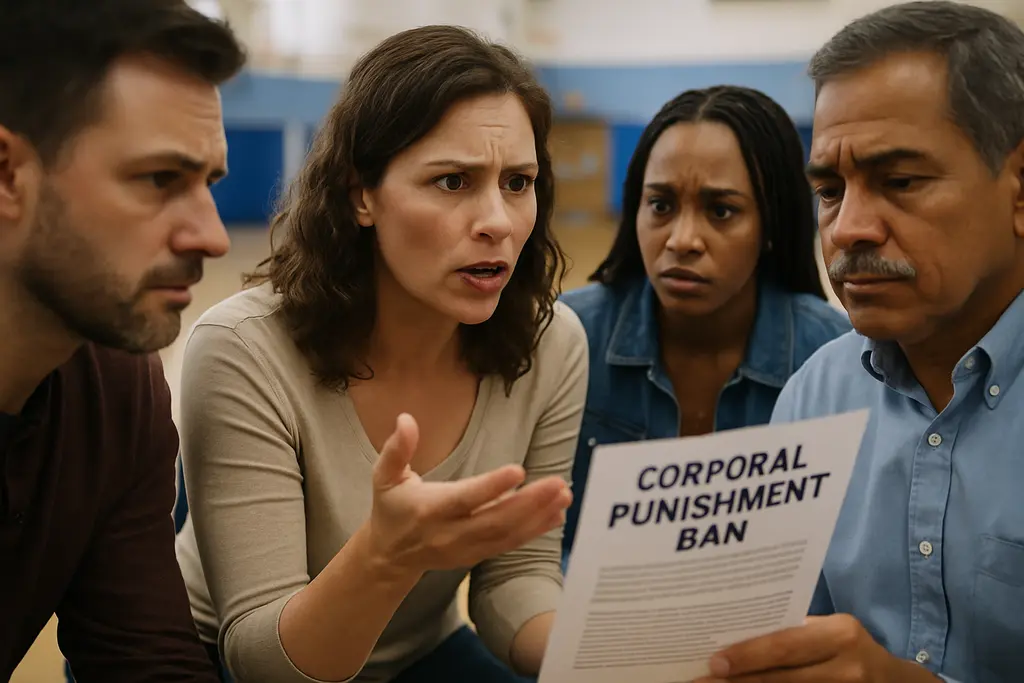
The proposed Corporal Punishment Ban introduced in the U.S. Senate on September 21, 2026, has drawn attention from families, educators, advocates, and survivor-support communities because it would move a school-discipline issue from state-by-state control toward a federal standard for schools receiving federal funds. The available record supports a careful reading: this was a proposal as of October 6, 2026, not an enacted federal law.
Senators Tim Kaine, Chris Murphy, Dick Durbin, Alex Padilla, and Chris Van Hollen introduced the Protecting Our Students in Schools Act on September 21, 2026, according to Senator Kaine’s office. The proposal has produced a mix of support, caution, and operational questions. That mix is not unusual for school policy: families often want stronger student protection, while districts must consider staff training, reporting systems, local discipline codes, and legal exposure.
For readers interested in civic and environmental topics, there is material worth exploring on these subjects. A related site in the same network, Earth Times, provides another example of specialized public-interest journalism. In education, the central question here is narrower: how would a federal proposal change local practices, and what do community responses reveal about student safety and trust?
Why The Corporal Punishment Ban Is Drawing Reaction
Federal Proposal, Not Enacted Law
The Corporal Punishment Ban debate begins with a legal distinction. The bill was introduced in the Senate; the research provided does not show final passage, presidential signature, or implementation as federal law by October 6, 2026. That matters for school boards and families because proposed statutory language can shape debate before it changes legal obligations.
The bill text for S. 5470 states that covered school personnel would be prohibited from inflicting physical pain on a student as a form of discipline in schools receiving federal financial assistance, according to the introduced Senate bill. The research also indicates that the proposal would apply to school personnel, including school security and law enforcement officers in federally funded schools.
Community reaction has therefore centered on both values and administration. Supporters frame the proposal as a student-protection measure, especially for children who may have experienced trauma or who are at greater risk of harsh discipline. Others may question whether federal legislation is the right instrument for an issue long governed by state law and district policy. The available research does not establish the full range of local opposition or support, so broad claims about national consensus should be avoided.
Student Safety And Local Control
School discipline policies sit close to family beliefs, teacher authority, and student rights. A federal restriction on physical discipline would affect how districts write codes of conduct, train employees, and respond to incidents. For survivor-support professionals and student advocates, the proposal also raises a prevention question: whether banning physical punishment can reduce the risk that school discipline becomes another source of harm for students already coping with adversity.
At the same time, district leaders would need clear procedures. A ban written at the federal level would still have to be understood in classrooms, principal offices, alternative programs, and school security operations. The gap between legal language and daily practice is where community engagement often matters most.
What The Proposal Would Change In Schools
Reporting And Family Notice
The research notes describe notice provisions tied to corporal punishment incidents, including written notification within 24 hours to parents, state education agencies, and local law enforcement. Because the legislation remained proposed, those requirements should be read as proposed duties rather than active nationwide mandates.
For families, timely notice could be one of the most concrete features of the proposal. A parent cannot respond to a school incident if the family does not know it occurred. For survivor-support groups, written notice may also create a record that can help identify patterns, gaps in supervision, or training needs. Still, the practical burden would fall on districts to determine who files the notice, what details are included, how privacy rules are handled, and how state reporting systems receive the information.
Students With Disabilities
The research also states that the bill includes additional protections and reporting for students with disabilities. That point is significant because school discipline intersects with federal disability protections, individualized education plans, behavioral supports, and staff training. If a child’s behavior is connected to a disability, physical punishment raises both safety and civil-rights concerns.
Advocacy groups identified in the research, including the Southern Poverty Law Center and the Intercultural Development Research Association, have publicly supported the proposed federal ban. Their stated concerns include harm to students, disproportionate effects on students of color and students with disabilities, and the need for alternative discipline methods. The available research supports reporting that such groups back the bill; it does not support assuming that every parent, educator, or local organization shares the same position.
Community Evidence Is Supportive But Uneven
Community Support For A Corporal Punishment Ban
A Fall 2020 national survey of 3,049 U.S. adults found that 65 percent agreed there should be a federal ban on physical punishment in public schools. That finding suggests that support for a Corporal Punishment Ban in school settings may be broader than many people assume.
The same survey found that only 18 percent believed most other U.S. adults shared that view. That gap is worth attention. If people underestimate public support for a school-based ban, local discussions may appear more polarized than they are. Parents or educators who support ending corporal punishment may stay quiet if they believe their position is a minority view, even where survey evidence suggests otherwise.
Limits Of Public Support
The survey results also show limits. Support for broader bans on all physical punishment, including in the home, was much lower, around 32 to 33 percent for federal or state bans. That distinction helps explain why the school proposal may draw wider support than more general restrictions. Many adults may see public schools as state-supervised institutions with different obligations than private family settings.
For policymakers, that distinction could shape messaging and implementation. The bill concerns schools receiving federal funds, not a universal ban on parental discipline in the home. Confusing those categories could inflame community meetings and distract from the actual text of the proposal.
Implications For Survivor Support And Interventions

Why School Climate Matters
Federal civil-rights data cited in the research reported 69,492 public school students receiving corporal punishment in the 2017-18 school year, down from 106,055 in 2013-14. The decline suggests that use had already decreased before the 2026 proposal, but the number remained large enough to keep the issue active for advocates and families.
The same data indicated that boys were about four times more likely than girls to receive corporal punishment in 2017-18. That disparity raises policy questions for districts even apart from federal legislation. If discipline practices fall unevenly across student groups, communities have reason to ask whether behavior interventions, adult responses, or school climate practices need review.
Alternatives Require Resources
A Corporal Punishment Ban would not, by itself, create effective discipline systems. If Congress or states restrict physical punishment, schools still need practical alternatives: de-escalation training, behavior supports, counseling access, restorative practices where appropriate, and clear staff expectations. The research notes that advocacy groups have called for alternative disciplinary methods to be funded and adopted.
That funding point is not secondary. A district can remove a harmful practice from policy and still leave teachers without tools for disruption, conflict, or crisis. Community engagement should therefore move beyond yes-or-no debate and ask what supports schools need to maintain safety without physical punishment.
Community Reactions To The Corporal Punishment Ban Proposal
The community response to the Corporal Punishment Ban proposal is best understood as layered rather than uniform. The available evidence shows organized advocacy support, survey-based public support for a school-specific federal ban, and likely administrative concerns for districts that would have to apply any new law. It does not show that the proposal had become binding law by October 6, 2026.
For families and survivor-support organizations, the proposal creates an opening to ask school boards direct questions: whether corporal punishment is allowed locally, how incidents are documented, whether parents are notified, and what alternatives are funded. For educators, the central issue is whether a discipline system can protect students while giving staff workable methods to maintain order.
The policy debate should stay anchored to the bill’s actual status and text. If the proposal advances, communities will need to examine implementation details. If it stalls, the discussion may still influence state legislation, district policy reviews, and local expectations about student protection. Either way, the reaction already shows that corporal punishment in schools remains a live education-policy issue, especially for communities focused on student safety, trauma-informed support, and fair discipline.