

The expansion of federal scholarships has moved from a national policy debate into a local planning question for families, school districts, unions, faith communities, and state officials. The Federal Scholarship Tax Credit, part of P.L. 119-21, has been enacted but does not take effect until January 1, 2027. That timing matters: communities are reacting now to a policy that is approved in law but not yet active in classrooms, household budgets, or state participation decisions.
The policy allows donors to receive a dollar-for-dollar federal income tax credit of up to $1,700 for contributions to approved Scholarship Granting Organizations. Those organizations may then distribute support for private school tuition, homeschooling, tutoring, special education supports, and related uses, according to EdChoice’s description of the program and survey findings EdChoice survey summary. The key community question is not only whether families welcome more options. It is also whether local public systems, especially those already facing enrollment and staffing pressure, can absorb the political and financial effects of a new federal incentive.
Federal Scholarships And Community Trust
Federal Scholarships Awareness Gap
Public reaction is divided less cleanly than the usual school-choice arguments suggest. The EdChoice “Schooling in America” survey, fielded from March 24 to April 4, 2026, found support for the Federal Scholarship Tax Credit among 72% of school parents and 61% of the general public. Opposition was lower in that survey: 12% of parents and 17% of the public opposed the policy. Those figures indicate that parent interest is real and should not be dismissed as a narrow advocacy position.
Yet the same survey reported a major information gap. Only 26% of school parents and 17% of all Americans said they had heard “a great deal” or “a lot” about the tax credit program. At least half in each group said they had heard “not that much” or “nothing at all.” For local leaders, that is a warning sign. Support measured before families fully understand eligibility rules, available schools, transportation limits, and state participation decisions may not predict how residents respond once implementation details become concrete.
Why Local Conversations Are Uneven
Community response depends heavily on local conditions. A family living near several private or religious schools may view the new credit as a practical opportunity. A family in a rural county or in a neighborhood without nearby participating schools may see the same policy as largely symbolic. The research record also points to concerns about transportation, the availability of private campuses, and ZIP-code wealth differences limiting who can benefit. Those issues do not negate parent demand, but they do shape whether the program functions as broad access or as a narrower subsidy for families already positioned to use it.
This is where public meetings, parent councils, and local reporting can provide a better picture than national polling alone. Districts and community groups can ask basic questions before January 1, 2027: Which Scholarship Granting Organizations are applying or expected to operate nearby? Which students are likely to qualify? Are participating schools accessible by public transit or school transportation? What public services would remain for students who do not move? These are practical questions, not partisan tests.
Parent Support Meets Limited Public Awareness
Support Is Not The Same As Implementation Consent
Support for federal scholarships in polling should be read with care. A parent may support the idea of more educational options while still objecting to weak disclosure rules, limited access for students with disabilities, or a process that shifts attention away from public school needs. Similarly, a resident may oppose the policy because of concerns about public funding without opposing families who seek alternatives for a child. Community engagement is strongest when it separates family motives from institutional effects.
The policy’s design also creates a communication challenge. Because the benefit is structured as a federal tax credit for donors rather than a direct state appropriation, many residents may not immediately see it as connected to public finance. Critics describe the program as similar to vouchers because federal tax revenue is reduced when donors claim credits. Supporters describe it as a scholarship mechanism that expands private giving. Local discussions should identify those competing descriptions clearly, because each framing leads communities to different conclusions about accountability.
Everyday Questions For Families
For families, the first round of concerns is likely to be practical. If a Scholarship Granting Organization is approved, residents will want to know how awards are prioritized, whether tuition support covers the full cost of attendance, and whether tutoring or special education supports are available in their area. Families also need clear information about whether receiving support changes access to public school services. The available research does not answer those local implementation questions in full, so school boards and state agencies should avoid overstating what is settled.
For public school communities, the concern is different. Even if a state does not directly spend its own revenue on the federal tax credit, a shift in enrollment can affect staffing, course offerings, transportation routes, and the public school’s civic function. Rural superintendents in some states have raised concerns about public schools that serve as community hubs. The scale of any effect will depend on participation levels after the program takes effect, which remains unresolved as of October 5, 2026.
Union And State-Level Pushback
Opt-Out Campaigns Are A Governance Signal
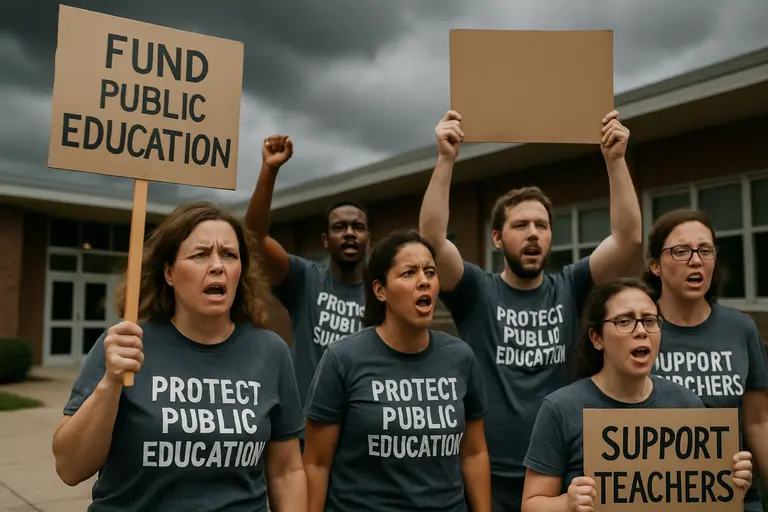
Teachers’ unions and public school advocates have responded by pressing governors and state leaders to reject participation or limit the program’s reach. In New York, teachers unions urged Gov. Kathy Hochul on September 17, 2026, to reject the federal tax credit program, arguing that it could divert students and resources from public schools, according to NY1’s report. The policy question there was not whether the federal law exists; it was how state leaders should respond before implementation.
Similar reactions in other states, as described in the research record, include calls for governors to opt out and concerns from education boards or advocacy coalitions about the use of public benefit for private school attendance. These objections are not simply institutional self-interest, though unions and districts have clear stakes. They also reflect a governance concern: if public policy subsidizes private education choices, what disclosure, nondiscrimination, and performance expectations should follow?
Accountability Questions Remain Open
Accountability is likely to become the central community issue once Scholarship Granting Organizations begin operating under the federal tax credit. Residents may ask whether participating organizations must report award distribution by income level, disability status, geography, or school type. They may also ask whether state officials will publish enough information for taxpayers to understand who benefits. The research provided for this analysis does not establish final reporting rules across states, so claims about local effects should be framed as questions until agencies release implementation details.
The debate also connects to a broader set of federal education policy changes. Readers following the fiscal side of the issue may want to compare this discussion with prior analysis of school funding and equity tradeoffs. For a broader viewpoint on intertwining public matters, Earth Times offers insights into civic-policy intersections.
What Federal Scholarships Mean For Local Schools
Community Engagement Should Start Before January 2027
The most useful local response before January 1, 2027, is not a slogan for or against the program. It is a shared fact base. State leaders can clarify whether and how they intend to participate. Scholarship organizations can explain application procedures, award priorities, and complaint processes. Public school districts can describe what they know, what they do not know, and how they would monitor enrollment shifts without blaming families for exploring options.
Community organizations can help by hosting forums that include parents from public, private, religious, homeschool, and special education settings. Those meetings should make room for families who feel underserved by current schools and for residents who worry about weakening public systems. Both reactions are visible in the research record. Treating one as authentic and the other as bad faith would reduce the quality of local decision-making.
A Narrower Test For The Policy Debate
The early reaction to federal scholarships shows a policy with measurable public support, limited public awareness, organized union opposition, and significant unresolved implementation questions. That combination calls for caution. Polling indicates many parents like the concept. Opposition from public school stakeholders signals concern about institutional stability. Neither fact, standing alone, tells a community whether the program will expand access equitably in a particular county or school district.
By October 5, 2026, the law had been enacted, but its operative date remained January 1, 2027. That leaves a short period for state officials, school boards, Scholarship Granting Organizations, and residents to make participation decisions more transparent. The best local measure will be whether families receive clear information, whether public schools can plan responsibly, and whether access extends beyond those already closest to private education options.