
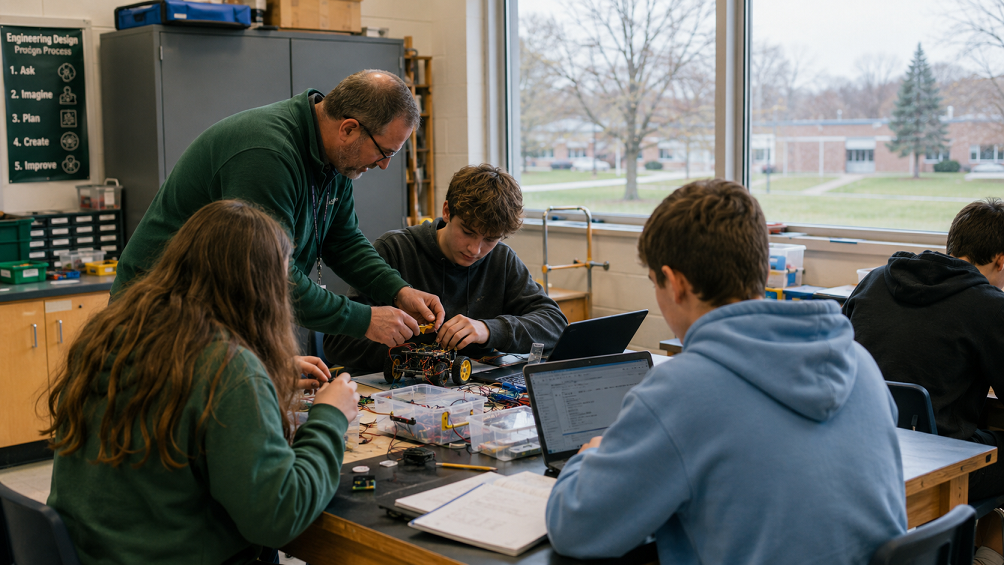
Salamanca City Central School District’s paused humanoid AI robot pilot has become a national test case for what happens when rural education innovation moves faster than public trust. The Western New York district announced on July 10, 2026 that it planned to launch a Realbotix educational robot and digital avatar in its high school STEAM program. Two weeks later, the project was on hold after New York State Education Commissioner Betty A. Rosa, unionized teachers, parents, and community members raised concerns about student privacy, classroom roles, and the implications of placing a humanlike AI system in a school.
The case is easy to caricature as a story about a robot named “Sally.” That would miss the more important education-policy issue. Rural districts need access to advanced technology, robotics, AI literacy, and career-connected learning. But when a district introduces an embodied AI system that resembles a human teacher or tutor, privacy review, community notice, vendor safeguards, and instructional boundaries must be stronger before the pilot reaches students.
What Salamanca Planned To Launch
On July 10, Salamanca City Central School District said it would introduce a Realbotix educational robot and digital avatar to support teaching and learning in its high school STEAM program. The district said a small group of students enrolled in Woz Ed Science, Technology, Engineering, Arts, and Mathematics courses, along with participating staff, would explore the resource during the school year.
The district’s official Realbotix pilot announcement framed the project as “Preparing Students for Tomorrow While Keeping Learning at the Center.” It said the system was loaded exclusively with district-approved curriculum, instructional strategies, and historical information about Salamanca. The district also said the robot would guide students through learning rather than complete work for them.
Salamanca’s privacy claims were specific. The district said the Realbotix system would not collect personally identifiable information, would not record video or audio, would not transmit data to Realbotix Corporation, and would operate under district policies and New York State privacy requirements. It also said the system would not search the internet, would not generate responses beyond its approved knowledge base, and would redirect inappropriate conversations back to educational content.
Those assurances matter because they show the district was not ignoring privacy. But public concern grew anyway. The gap between district assurances and community trust is the real lesson for schools considering AI tools, especially those that look or act like human instructors.
Why The Pilot Was Paused
AP reported that Salamanca’s school board approved the nearly $60,000 Realbotix purchase with hopes that the robot, nicknamed “Sally,” would support high school students studying robotics and technology fields. Superintendent Mark Beehler said students could ask the robot for help with topics such as Arduino programming, and he described the pilot as a way for students to learn how the robot is maintained, updated, and troubleshot through the AP report on Salamanca’s robot pause.
The plan changed after the New York State Education Department intervened. New York Focus reported that Salamanca announced the project was on hold on July 24, 2026, hours after Commissioner Rosa sent a letter to Beehler expressing concern about the effect a humanoid robot could have in a high school classroom. Rosa’s letter also cited concerns from parents, teachers, and stakeholders about AI technology in classrooms, especially when robots resemble humans.
The district’s pause was not a permanent cancellation. Salamanca said the pilot was on hold while it worked through enhanced student data privacy agreements with NYSED and continued engaging with the community. That language is important. It suggests the central issue was not only whether the robot was interesting or innovative, but whether the governance structure around the pilot was strong enough.
New York State United Teachers President Melinda Person strongly objected to the project and said students need real relationships with caring adults, not robots. NYSUT also objected to Realbotix’s corporate associations with adult humanoid products. District officials and Realbotix stressed that the education system and those products are separate, but the concern still shaped public perception.
Rural Innovation Deserves Serious Treatment
Salamanca is not wrong to pursue ambitious technology learning. Rural students should not be last in line for robotics, AI literacy, advanced STEAM pathways, career-connected learning, or exposure to emerging technologies. In many rural communities, schools are one of the few institutions capable of giving students hands-on access to tools that may shape future work.
That is why the policy answer cannot simply be “no robots in schools.” A blanket rejection of emerging technology can deepen inequity if affluent districts and private schools experiment while rural students are left with outdated tools. The better question is what public safeguards should exist before a district pilots a system this sensitive.
This is where The Parative Project’s recent state AI laws for schools coverage becomes relevant. States are increasingly moving from AI guidance to required local policies because district-level experimentation is already happening. Salamanca shows why policy cannot only address chatbots, plagiarism, or teacher lesson planning. It must also address embodied AI, AI avatars, tutoring systems, student identifiers, local data storage, vendor claims, and community review.
Rural innovation needs stronger review precisely because rural districts often have less margin for error. A single controversial purchase can dominate local trust, burden administrators, divide families, and distract from the legitimate goal of expanding student opportunity.
The Privacy Issue Is Not Solved By Saying “No PII”
Salamanca’s announcement said the Realbotix system would not collect personally identifiable information, record video or audio, or transmit data to the company. Those are important claims, but a strong privacy review should go deeper.
A district should define what counts as personally identifiable information, whether students use unique identifiers, what interaction logs exist, where those logs are stored, who can access them, how long they are retained, whether data can be combined with course records, whether students can opt out, whether parent notice is required, whether the vendor has any maintenance access, and whether the system can be updated remotely.
New York’s student data privacy framework gives districts a reason to be careful. NYSED’s Data Privacy and Security office says that under New York Education Law §2-d, the Chief Privacy Officer issues annual reports covering data privacy and security activity, reported breaches, and complaints involving possible breaches of student data or teacher or principal evaluation data through the NYSED data privacy annual reports.
That framework does not automatically answer every question about humanoid AI. It does show that New York treats student data privacy as an ongoing governance obligation. If a system is unusual enough to trigger state concern, the district should publish more than a broad assurance. It should publish a plain-language privacy review.
Families do not need marketing language. They need a clear explanation of what the tool can and cannot do.
The Humanlike Design Changes The Policy Standard
A humanoid robot creates a different classroom question than a laptop app. Students may respond differently to a system with a face, voice, expressions, gestures, and a teacher-like role. Even if the robot is stationary and limited, its design may create a sense of relationship, authority, or social presence that ordinary software does not.

That is why the question is not only data privacy. It is also instructional role clarity. Is the robot a demonstration tool for robotics? A tutoring platform? A teacher’s assistant? A classroom engagement device? A career-readiness artifact? Each role carries different risks.
AP reported that Commissioner Rosa remained concerned after staff met with the district, especially because a board presentation characterized the robot as a “tutoring platform” even as the district said it would not deliver classroom instruction. That distinction matters. A robotics demonstration that students inspect and critique is one thing. A tutoring platform that interacts with students about coursework is another.
Districts should create a higher review standard for AI systems that mimic human relationships. That review should ask whether the system speaks in a teacher-like voice, provides feedback, addresses students by identifier, adapts to prior interactions, uses emotional cues, or encourages repeated one-on-one interaction. If the answer is yes, the pilot needs stronger safeguards than a standard classroom device.
What A Strong AI Pilot Review Should Include
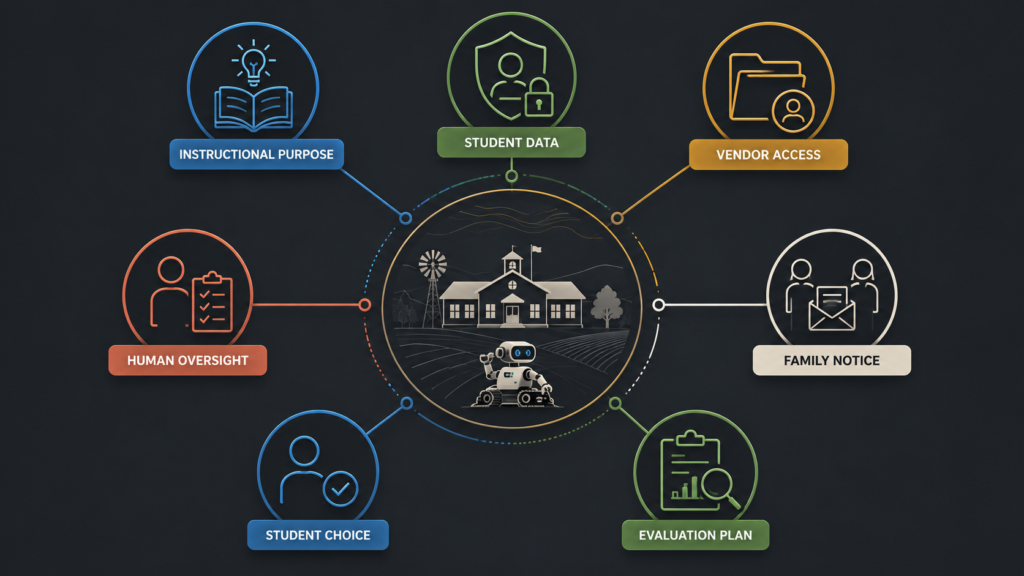
Salamanca’s pause gives other districts a practical checklist. Before launching a visible or sensitive AI pilot, school boards should require a written review that connects instructional purpose, privacy safeguards, teacher oversight, family notice, and student protections.
| Review Area | What Districts Should Explain |
|---|---|
| Instructional Purpose | Why this tool is needed and what learning goal it serves |
| Student Data | What data is collected, stored, shared, retained, or deleted |
| Vendor Access | Whether the company can access logs, updates, identifiers, or student interactions |
| Human Oversight | Which trained educators supervise use and review outputs |
| Family Notice | How parents learn about the tool before students use it |
| Student Choice | Whether students can opt out or use an alternative activity |
| Evaluation Plan | How the district will measure benefits, harms, and unintended effects |
The evaluation plan is especially important. A district should not pilot AI because it is novel. It should define what success means. Did students learn more about robotics? Did the tool increase participation? Did it improve understanding of AI limitations? Did it protect privacy? Did teachers find it useful? Did families trust the process? Did any student feel pressured, uncomfortable, or excluded?
Without an evaluation plan, an AI pilot becomes a public relations event rather than an educational experiment.
Teachers Should Be Partners, Not An Afterthought
The Salamanca controversy also shows why teachers must be included before technology is announced. Teachers are the adults who will manage the classroom, answer student questions, reassure families, and respond when something goes wrong. If they learn about a major AI pilot after the purchase is approved, trust will already be damaged.
NYSUT’s criticism was forceful, but one point should be uncontroversial: technology decisions that affect teaching should involve educators. Teachers can identify practical issues that vendors and administrators may miss. They can ask how the tool aligns with curriculum, how it affects classroom relationships, what happens when it gives an inadequate answer, how students might misuse it, and whether it adds meaningful learning value.
The Times Union reported that NYSUT asked state policymakers to create statewide rules for AI in schools, including heightened protections when AI is humanoid, embodied, or designed to mimic human relationships. NYSED spokesperson J.P. O’Hare said the department has been developing statewide guidance for AI and emerging technologies for months, while noting that changes to state law governing classroom technology would ultimately require legislative action through the Times Union report on New York AI policy.
That gap between guidance and law matters. Until statewide rules exist, districts need their own public process for teacher review.
Community Notice Should Come Before The Purchase
Public engagement works best before a school board vote, not after backlash. Families should not first hear about a humanoid AI system through social media, a news article, or a union statement. They should receive a plain-language explanation before the district spends public money.
A strong community notice should include the vendor name, purchase price, purpose, student group involved, privacy safeguards, teacher role, opt-out option, timeline, evaluation plan, and contact person. It should also explain what the technology will not do. If the district says the robot will not record audio, it should explain whether microphones exist and how they are disabled or limited. If it says the robot will not transmit data, it should explain how updates, maintenance, and troubleshooting work.
The notice should also acknowledge community context. Salamanca is located on the Allegany Territory of the Seneca Nation of Indians, and rural Indigenous communities have long histories of outside systems making decisions that affect students without enough local trust. That does not mean technology pilots are inappropriate. It means the public process must be more careful, not less.
A district that wants families to trust innovation must show that the community was invited into the decision before the equipment arrives.
The Larger Lesson For EdTech Governance
Salamanca’s paused robot pilot is not an argument against rural AI education. It is an argument for better governance before districts introduce tools that are highly visible, emotionally charged, and data-sensitive.
The future of school technology will not be limited to screen-based apps. Districts will face AI tutors, avatars, adaptive agents, robotics systems, voice assistants, classroom analytics tools, translation supports, special education compliance tools, and virtual coaching platforms. Some may help students. Some may waste money. Some may create privacy or trust problems that were predictable before launch.
The districts best prepared for that future will not be the ones that buy the most futuristic tools. They will be the ones that can answer hard questions early: What problem are we solving? What data is involved? Who reviewed the vendor? How are teachers involved? What do parents know? What are students told? What happens if the pilot fails?
Salamanca’s pause should be treated as a warning and an opportunity. The warning is that AI innovation can lose public trust quickly when the safeguards are unclear. The opportunity is that districts can still design better review systems before the next pilot begins.
Rural students deserve access to advanced AI and robotics education. They also deserve privacy, human-centered teaching, family transparency, and public accountability. A school system should not have to choose between innovation and protection. It should prove, before launch, that it has built both.