
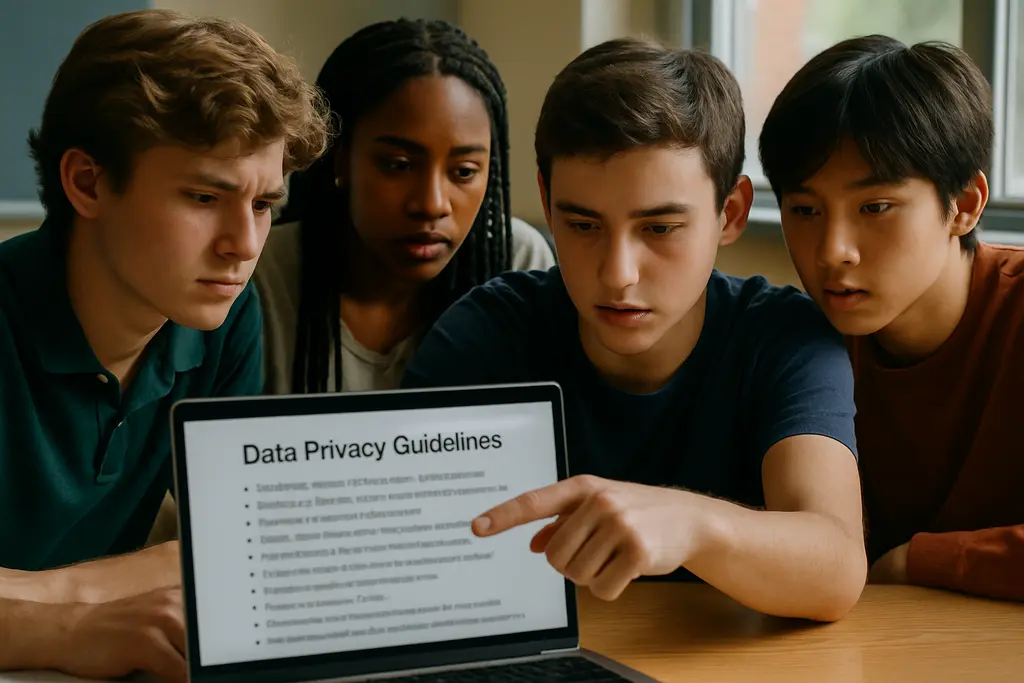
Microsoft’s September 2026 agreement with two major teachers’ unions has shifted student data privacy from a general concern into a more concrete test for school AI deployment. The policy change did not settle every question about classroom AI, but it gave districts, educators and families a clearer set of standards to examine before student-facing tools are turned on.
On September 9, 2026, Microsoft, the American Federation of Teachers and the United Federation of Teachers announced a National AI Safety & Privacy Standard for U.S. schools. Microsoft said the standard created legally enforceable protections intended to prevent technology companies from using student or educator data to train AI, track students, sell data for advertising or make AI-driven decisions without human oversight, according to the company’s September 9 announcement.
The timing matters. As of October 7, 2026, the agreement had already been announced and was being treated by major districts as part of a wider review of AI tools. The practical effect is less about one company’s product language and more about whether districts can prove that educational AI systems match their privacy, safety and instructional obligations before students use them.
Student Data Privacy Rules Move From Promise To Practice
What Student Data Privacy Now Restricts
The student data privacy commitments described in the September agreement set a boundary around several uses that have drawn concern from educators and families. Under the standard, student and educator data cannot be used to train AI systems, sold for advertising or used for AI-driven decisions without human oversight. The research record also states that lesson plans, assignments and conversation contents are off-limits for Microsoft foundation model training, aside from narrowly defined telemetry used for safety or debugging.
That distinction is central for school deployment. Districts have long used digital tools that collect student information, but generative AI can create new questions about whether classroom material becomes training data, whether student interactions are stored in ways families can understand and whether automated outputs influence instruction, discipline or support decisions. The Microsoft standard responds to those concerns by placing limits on model training, tracking and high-risk automated decision-making.
Ownership, Deletion And Plain-Language Notice
The September materials also describe school control over how data is used, stored, encrypted, retained, deleted or exported. Any change in data use must be disclosed to schools and parents in plain language. For local education agencies, that moves the discussion from broad vendor trust to specific contract terms: who owns the data, what the vendor may do with it, how long it remains stored and how it can be removed.
This matters because a district may approve an AI tool for instructional reasons while still lacking clear procedures for data export, deletion or breach response. The research record states that breaches connected to Microsoft educational AI tools must be reported to customers within 72 hours, even if the contract has ended. That is a concrete benchmark districts can compare against their own procurement policies and other vendors’ terms.
What Changed In Microsoft’s School AI Standard
Human Oversight And High-Risk Uses
The new standard treats some AI uses as higher risk than routine classroom assistance. Biometric tools, profiling, tracking and AI companions face extra scrutiny or bans under the policy. AI companions designed to foster emotional attachment are explicitly prohibited in the research materials.
For educators, this is not just a technical distinction. A writing coach, study support agent or planning tool raises different issues than a system that profiles a student, tracks behavior or simulates a relationship. The September standard appears to draw a line between tools meant to support learning tasks and tools that could shape identity, behavior or emotional dependence. That line will still require local review, because districts need to know what a tool actually does, not only how it is marketed.
Age Controls And Managed School Accounts
Microsoft’s Study and Learn Agent, released as part of the company’s 2026 AI-in-education offerings, is described as keeping student content inside the school’s Microsoft 365 tenant, encrypting data in transit and at rest, limiting access to conversation history and not using student materials or chats to train Microsoft’s models. The research record also states that the tool is available only to users aged 13 and older, with K-12 access managed through school accounts that enforce age checks.
Those details show how student data privacy can no longer be separated from age-based deployment. A district may need one policy for staff use, another for older students and a different approach for younger grades. The question is not simply whether AI is allowed. It is whether the user’s age, account type, data pathway and instructional purpose fit the safeguards attached to the tool.
District Deployment Became A Governance Test
Microsoft’s policy shift did not occur in isolation. Major districts had already been under pressure to decide whether student-facing AI should be paused, limited or approved under stricter conditions. The Washington Post reported that New York City and Los Angeles, the two largest U.S. school districts, instituted a one-year moratorium on student use of AI tools at the start of the 2026-2027 school year to audit ed-tech contracts, evaluate compliance with privacy and safety standards and decide appropriate age and grade-level deployment, according to The Washington Post.
That step is significant because it treats AI adoption as a governance problem, not only a classroom innovation question. A moratorium can frustrate teachers who want approved tools, but it can also give districts time to inspect contracts, map data flows and decide which uses are acceptable by grade level. The key test is whether the pause produces clear rules rather than a vague delay.
The same issue appears in local contract review. A district must be able to answer several practical questions before deployment:
- Does the vendor use student or educator data to train AI models?
- Can the district delete, export and control the data after use?
- Are parents and schools notified in plain language when data use changes?
- Does the product include human oversight for consequential decisions?
- Are age limits and school-managed accounts enforced in practice?
Those questions connect directly with earlier reporting by The Parative Project on Microsoft’s AI pact, especially the need for contract tools that cover privacy, human review, breach notice and deletion. Related civic-policy coverage from CA Views has also tracked the responses of public institutions when national policy debates impact local communities.
What Parents And Educators Can Ask Locally

What Is Confirmed And What Is Unresolved
The confirmed record is that Microsoft, AFT and UFT announced a national standard on September 9, 2026, and that the standard includes limits on model training, tracking, advertising uses and AI-driven decisions without human oversight. The record also supports that certain high-risk features, including emotional-attachment AI companions, are barred under the standard, and that Microsoft’s Study and Learn Agent includes stated tenant, encryption, access and model-training protections.
What remains unresolved is whether other technology companies will adopt similar protections, whether districts will be able to verify compliance across all vendors and how consistently local schools will communicate these rules to families. The September agreement may shape contract expectations, but the research materials reviewed here do not show that it created a new federal statute or a single national rule binding every ed-tech provider.
Questions For School Boards And District Teams
Parents and educators do not need to be software engineers to ask useful questions. The most productive local discussion starts with documents and accountability. Districts can identify which AI tools are approved, which are paused, which data each tool collects and which staff member is responsible for contract enforcement. School boards can also ask whether breach notice timelines, deletion rights and human review requirements are written into vendor agreements rather than described only in public statements.
Educators have a separate stake in the outcome. The Microsoft agreement covers both student and educator data, meaning lesson plans, assignments and classroom interactions are part of the privacy discussion. Teachers asked to use AI tools should know whether their instructional materials are used for model training, who can review stored prompts or chats and how long those records remain available.
Student Data Privacy In Educational AI Deployment
The main policy lesson from Microsoft’s September 2026 standard is that educational AI deployment now depends on verifiable safeguards, not general assurances. Student data privacy has become a condition for classroom use, especially where tools store conversations, process assignments or make recommendations that could affect learning support.
For districts, the next phase is operational. Leaders need a clear inventory of AI tools, contract language that matches public promises, age-based access rules and a process for explaining data practices to families. For parents and teachers, the strongest questions are specific: what data is collected, whether it trains AI models, who can see it, when it is deleted and whether a human reviews consequential decisions.
Microsoft’s standard gives school systems a reference point. It does not remove the need for local oversight. The real impact will be measured by whether districts use these protections to approve AI tools carefully, pause tools that do not meet the standard and give families plain-language answers before student data enters an AI system.