

California parents challenging i-Ready’s student data practices have pushed one of the country’s most widely used education platforms into a broader debate over privacy, screen time, and classroom equity. The lawsuit, filed against Curriculum Associates, the company behind i-Ready, alleges that the platform collects and shares sensitive student information without proper parental consent. Curriculum Associates denies the claims and says it does not sell student data, use student data for advertising, or build commercial profiles on students.
The case matters beyond one company or one product. i-Ready is used by districts across the country for diagnostic testing, progress monitoring, and online instruction. In Los Angeles Unified School District, Guardian reporting said Curriculum Associates has a $20 million contract, while families and teachers are already debating whether classroom technology is being used too often, measured too poorly, and explained too vaguely. The lawsuit turns that debate into a sharper question: when schools require children to use private edtech platforms, who is accountable for what happens to their data?
Why The i-Ready Lawsuit Is Bigger Than One Platform
The lawsuit centers on i-Ready, an adaptive assessment and instruction platform used in reading and math. According to the case summary maintained by the EdTech Law Center, M.C. v. Curriculum Associates was filed on Dec. 22, 2025, and challenges the company’s generation, collection, use, and sharing of information about K-12 students. The claims include federal and state privacy-law theories, including allegations involving consent and data collection through the i-Ready lawsuit record.
Guardian reporting published June 11, 2026 identified two California parents connected to the case: Lila Byock, whose children attend LAUSD schools, and Nicki Petrossi, whose children formerly attended public school in the Fullerton School District. The report said the plaintiffs allege that Curriculum Associates collects data such as race, gender, grade level, school name, disability status, IP addresses, responses to assessment questions, and time spent answering questions.
Those allegations are contested. Curriculum Associates has published a public litigation response saying the claims are “legally meritless.” The company says i-Ready requires limited personal information necessary to deliver the assessment and instruction services requested by school customers, and it says it does not sell student data to third parties or use student data for advertising through its i-Ready privacy response.
That disagreement is exactly why the case has become an equity issue. Families often do not choose whether a child uses a district-selected platform. The school assigns it. A student may need to log in because the platform is tied to assessment, progress monitoring, intervention, or teacher recommendations. When participation is effectively required, privacy cannot be treated as a consumer choice.
The Consent Question Schools Cannot Ignore
The central policy question is consent. Edtech companies often operate through district contracts. Districts adopt platforms, set up student accounts, and use the results for classroom or administrative purposes. Parents may sign a broad technology or internet-use agreement at the start of the year, but that does not always tell them which vendors collect which data, how long records are retained, whether third parties receive information, or how students are profiled inside adaptive systems.
The Federal Trade Commission’s COPPA guidance says the Children’s Online Privacy Protection Act generally requires online services directed to children under 13 to provide notice and obtain verifiable parental consent before collecting personal information from children. In school settings, the FTC has long recognized that schools may consent on behalf of parents in limited educational contexts, but that consent must be tied to educational use rather than unrelated commercial purposes through the FTC COPPA guidance.
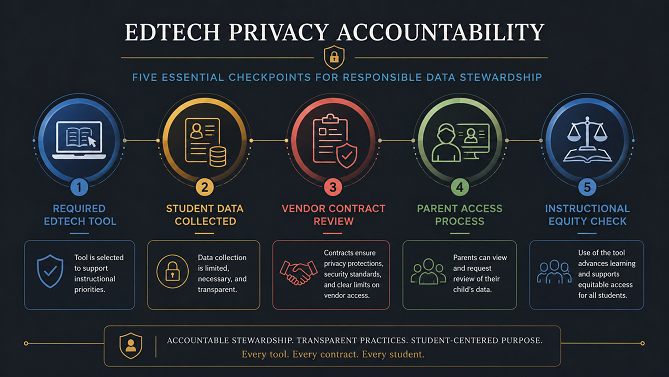
That framework leaves difficult questions for districts. If a school consents for a platform, what exactly did it approve? Did the district review the data categories? Did it confirm whether student data is shared with subprocessors? Did it explain the tool to parents in plain language? Did it offer a way to review records or request alternatives? Did the district check whether the platform collects more information than instruction requires?
The i-Ready lawsuit makes those questions harder to avoid. A district cannot simply tell families that “the vendor handles privacy.” Public schools choose the vendor, require the use, rely on the data, and integrate the platform into instruction. That means district accountability travels with the contract.
Why LAUSD Makes The Issue National
LAUSD is a major reason the i-Ready lawsuit has drawn wider attention. The district is the nation’s second-largest school system and has already become a national example in the screen-time debate. Guardian reporting said LAUSD’s i-Ready contract began in 2023 and is worth $20 million. It also reported that i-Ready is used for diagnostic testing in English and math several times during the school year, with lesson use varying by school.
That local context connects directly to The Parative Project’s recent LAUSD screen-time limits analysis. LAUSD has approved grade-level limits on screen use, with the youngest students facing the strictest reductions. That policy asks whether less device time can improve learning. The i-Ready lawsuit asks a related question: when digital platforms remain in use, can districts prove the data practices are necessary, lawful, and equitable?
The issue is not whether assessment data has value. Diagnostic information can help teachers identify reading gaps, math misconceptions, intervention needs, and student growth patterns. The equity problem appears when data collection becomes broad, opaque, or disconnected from clear instructional benefit.
A student in a high-poverty school may be assigned more platform time because the district uses digital intervention to address achievement gaps. A student with a disability may generate more sensitive performance data because the tool tracks responses, time, and progress. A student learning English may rely on digital supports that create additional usage records. If those students are monitored more heavily than peers, edtech privacy becomes part of the opportunity-gap conversation.
What Student Data Can Reveal In A Classroom
Student data inside adaptive learning systems can be more sensitive than families may realize. A platform does not only record whether a student logged in. It may track answer patterns, time on task, mistakes, skill levels, reading performance, math progress, frequency of use, accommodations, school, grade, device information, and classroom placement.
Some of that data can help teachers. A reading intervention platform may show where a student is struggling. A math diagnostic may help identify missing prerequisite skills. Progress reports may support parent conferences or school planning. The problem is not the existence of learning data. The problem is whether the data is collected narrowly, protected strongly, explained clearly, and used only for the educational purpose families were told about.
The U.S. Department of Education’s Student Privacy Policy Office says FERPA gives parents certain rights to inspect and review education records maintained by schools receiving federal funds. The department’s parent guide says schools must provide parents an opportunity to inspect and review education records within a reasonable time, and no later than 45 days after a request through the FERPA parent guide.
FERPA does not solve every vendor-data question. A parent may not know whether a vendor log, adaptive profile, device identifier, or platform interaction record is treated as an education record. A district may hold some records while a vendor holds others. That is why district contracts and privacy notices matter. Families need to know what exists before they can ask to inspect it.
EdTech Privacy Is Now A Classroom Equity Test
Equity in edtech used to focus heavily on access: who had a device, who had broadband, who could complete homework online, and who was left out. Those questions still matter. The i-Ready lawsuit shows that access can create a second layer of inequity if students with fewer alternatives are required to trade more personal data for basic instruction.

Students in wealthier families may be more likely to push back, request alternatives, ask for records, or transfer away from a platform-heavy school. Students in under-resourced schools may be assigned more digital remediation because software is cheaper or easier to scale than smaller classes, reading specialists, tutoring, or teacher-led intervention. That pattern can turn technology into a substitute for human support.
A privacy-centered equity review should ask whether a platform is used because it improves instruction or because it reduces labor. It should ask whether students spend more time with software because they need personalized help or because the district has normalized screen-based remediation. It should ask whether families understand the data tradeoff. It should ask whether children with disabilities, English learners, and low-income students are subject to heavier digital monitoring.
The Center for Democracy & Technology has warned that data-intensive school technologies can raise civil rights and privacy concerns when schools lack strong oversight. Its student privacy work emphasizes transparency, governance, and safeguards in education technology through CDT student privacy research.
That kind of oversight matters because schools are not ordinary app marketplaces. A child cannot negotiate terms with a district vendor. A parent cannot always say no without affecting assessment, grades, intervention, or classroom participation.
What Districts Should Publish Before Requiring Platforms
Districts do not need to wait for a court ruling before improving edtech transparency. The lawsuit has already identified the kind of questions families will keep asking. School boards and superintendents should treat those questions as governance issues.
A stronger district policy would publish a plain-language edtech inventory. It should identify required platforms, the grade levels using them, the instructional purpose, the data collected, the vendor receiving the data, the contract term, retention rules, parent access rights, and available alternatives. Districts should update the inventory at least once a year and link it from school technology pages.
| District Disclosure | Why Families Need It |
|---|---|
| Required platform list | Shows which tools students must use for class, testing, or intervention |
| Data categories collected | Explains whether the tool collects demographics, performance, device, or usage data |
| Vendor and subprocessors | Identifies who may handle student information |
| Retention period | Tells families how long data may remain after use |
| Parent access process | Gives families a clear path to review records or ask questions |
| Alternative options | Protects students when privacy, disability, or instructional concerns arise |
The strongest districts will also review whether a platform’s educational value justifies the data collected. A tool that collects sensitive data should meet a higher evidence standard than a simple classroom resource. If a district cannot explain how the data improves instruction, it should reconsider the contract.
Teachers Should Not Carry The Privacy Burden Alone
Teachers often become the front line for edtech questions they did not create. A parent asks why i-Ready is required. A student asks whether the platform tracks them. A teacher sees a report but does not know what data the vendor stores. A principal encourages platform minutes because the district wants benchmark data. Privacy risk then lands on classroom staff without the contract authority to answer it.
That is unfair to teachers and families. District leaders should provide teachers with plain answers: what the platform does, why it is used, what data it collects, what families can request, and how to report concerns. Teachers should not have to interpret vendor privacy policies or defend district procurement choices during parent conferences.
Teacher judgment should remain central to whether a tool is instructionally useful. If a platform identifies a reading gap, the teacher still needs time and resources to respond. If software assigns practice, the teacher still needs to decide whether it matches the student’s real needs. If a diagnostic score is wrong or incomplete, the teacher should be able to challenge it.
That human review is especially important for students with disabilities. A digital assessment may not capture the full effect of accommodations, fatigue, anxiety, language processing, motor needs, or assistive technology. Districts should avoid treating platform reports as complete portraits of students.
What The Lawsuit Could Change Even Before A Verdict
The lawsuit may take time to resolve, and the final outcome is uncertain. Yet it can still change district behavior now. School boards may ask harder questions before approving edtech contracts. Parents may request more data access. Teachers may push for clearer platform-use rules. Vendors may revise privacy notices, consent practices, subprocessors, or data-minimization policies.

Curriculum Associates has denied wrongdoing and says it is proud of its privacy practices. Plaintiffs say the consent and data practices are inadequate. Courts will sort through the legal claims. Districts do not need to wait to improve transparency.
The most useful response is not panic or a blanket rejection of all edtech. Some digital tools help students learn, help teachers identify needs, and expand access. The useful response is disciplined governance: collect less data, explain more clearly, review vendors more often, protect sensitive students, and prove that screen time serves learning.
California’s i-Ready lawsuit has turned edtech privacy into a classroom equity issue because student data is now part of instruction itself. If a platform determines what students practice, how progress is reported, and which children receive intervention, then privacy is no longer a back-office technology concern. It is a student-rights concern, a teaching concern, and a public accountability concern.