

A federal appeals court has ended more than 60 years of federal oversight in a Louisiana school desegregation case that began when Black families in Ferriday sued for access to all-white schools. The July 14, 2026 decision by the U.S. Court of Appeals for the 5th Circuit brought the Concordia Parish School Board case to a close after the remaining parties — the United States, Delta Charter Group, and the School Board — filed a joint stipulation of dismissal with prejudice.
The ruling does not erase the history that produced the case. It also does not answer every equity question that federal supervision once helped keep in public view. The legal order may be over, but the public accountability problem remains: when court oversight ends in a district shaped by decades of segregation, demographic separation, and uneven local resources, who tracks whether educational opportunity is actually equitable?
What The 5th Circuit Decided
The 5th Circuit’s decision in In re School Board of Concordia Parish focused on a procedural question: whether the federal district court could continue adjudicating a decades-old desegregation case after every remaining party filed a Rule 41(a)(1)(A)(ii) stipulation of dismissal. The appellate court held that once the stipulation was filed, the case was immediately dismissed without the need for a court order. It granted mandamus relief and ordered the district court to vacate its orders and end the proceedings through the 5th Circuit Concordia Parish ruling.
That distinction matters. The court did not conduct a fresh educational-equity review of Concordia Parish schools. It did not issue a broad factual finding that all vestiges of prior segregation had been eliminated. It concluded that the district court no longer had authority to keep the case alive after the remaining parties filed the stipulation.
The dissenting portion of the opinion made that tension clear. It noted that Concordia Parish had not yet been declared unitary by a federal judge through the traditional process rooted in Brown v. Board of Education, Green v. County School Board of New Kent County, and related desegregation precedent. The majority treated the Rule 41 stipulation as decisive. The dissent focused on the public-policy risk of ending a school desegregation case without the usual unitary-status determination.
For school equity policy, that split is the heart of the matter. A case can end procedurally even when the educational questions that gave rise to the litigation remain relevant.
Why Concordia Parish Became A National Flashpoint
The Associated Press reported that the Concordia Parish case dates to 1965, when Black families in Ferriday, Louisiana, sued for access to all-white schools and the federal government intervened. AP also reported that the area was racially segregated and connected historically to violent Ku Klux Klan activity, and that as Concordia Parish integrated its schools, many white families left Ferriday.

That history helps explain why the end of the order carries national significance. Desegregation orders were not ordinary administrative paperwork. They were court tools designed to force districts to dismantle legally segregated school systems. In many communities, those orders shaped attendance zones, faculty assignment, transportation, school construction, program access, and student enrollment patterns.
The AP report on Concordia Parish described the district’s current geography as still reflecting the demographics of surrounding areas: Ferriday remains mostly Black and low-income, while nearby Vidalia is mostly white and benefits from tax revenue connected to a hydroelectric plant. That local detail matters because school equity is often shaped not only by district policy, but also by housing patterns, tax bases, transportation, school boundaries, and parent choice.
The case also became part of a broader federal shift. AP reported that the Trump administration has pushed to end Civil Rights-era desegregation cases, with officials framing remaining orders as federal intrusion into local school governance. Louisiana Attorney General Liz Murrill welcomed the Concordia decision as returning authority to locally elected officials.
That argument will resonate with people who believe decades-old court supervision should not continue indefinitely. But local control is not the same as equity oversight. The question now is what public system replaces the court’s role.
The Difference Between Ending Oversight And Measuring Equity
Ending a desegregation order is a legal event. Measuring whether students have equitable access is an ongoing governance task. Those are not the same thing.
A court order may require reports, hearings, and compliance plans. Once it ends, districts may no longer face the same federal supervision. But disparities can still exist in discipline, advanced coursework, teacher experience, school facilities, extracurricular access, transportation, special education identification, gifted programs, graduation pathways, and academic outcomes. Some disparities may reflect broader community conditions. Others may reflect district choices.
That is why The Parative Project’s earlier Springfield curriculum ruling analysis is relevant. Equity governance cannot rely only on broad values language. It needs records, decision points, data, and transparent accountability. When courts step back, local institutions must show how they will keep measuring opportunity.
A district emerging from desegregation oversight should be able to answer basic questions. Are students across racial and income lines attending schools with comparable academic programs? Are discipline rates monitored by race, disability, sex, and school site? Are experienced teachers distributed fairly? Are magnet, charter, gifted, dual enrollment, and career pathways accessible? Are facility investments balanced? Are community concerns documented and addressed?
If those questions are not asked locally, the end of federal oversight can become the end of public visibility.
Delta Charter Shows Why The Case Was Still Operational
The Concordia Parish order was not only about a distant past. AP reported that the order was used to require a mostly white charter school that opened in 2013 to prioritize Black students and create a more integrated student body. Court records also show that Delta Charter Group had been part of the continuing litigation because its enrollment practices intersected with Concordia Parish’s desegregation obligations.
That history is important because charter enrollment, school choice, and attendance patterns can reshape segregation even after legally separate schools are gone. A district may no longer operate explicitly segregated schools, but choice systems can still concentrate students by race, income, geography, or access to transportation.
The federal appeal involved Delta Charter Group, the Concordia Parish School Board, and the United States as the remaining parties. The parties’ agreement to dismiss ended the case. But the presence of a charter dispute in a desegregation case shows why modern equity oversight cannot focus only on traditional neighborhood schools.
Local boards should review how charter schools, specialty programs, transfers, attendance zones, and transportation interact. If a choice program is technically open to everyone but difficult for some families to access, the policy may reproduce separation without naming race. If a school draws a more advantaged population while another campus serves more concentrated poverty, local leaders need to explain how they will monitor the effects.
What Local Equity Oversight Should Look Like Now
Concordia Parish’s federal order may be over, but a responsible local oversight system should remain. The point is not to recreate court control under another name. The point is to ensure that local governance produces public evidence of fairness.
A strong post-order equity framework would include annual public reporting, disaggregated student data, community meetings, school-by-school program reviews, and board-level monitoring. It should be written clearly enough for families to understand and specific enough for officials to act on.
| Oversight Area | Local Question To Track |
|---|---|
| Enrollment Patterns | Are schools becoming more racially or economically isolated? |
| Academic Programs | Do students across campuses have comparable access to advanced and career pathways? |
| Discipline | Are suspension, expulsion, and referral rates monitored across student groups? |
| Staffing | Are experienced teachers and certified specialists distributed fairly? |
| Facilities | Are capital improvements and maintenance needs addressed equitably? |
| School Choice | Do charter, transfer, and specialty options expand access or deepen separation? |
The district should also create a public process for families to raise equity concerns outside of litigation. That could include a board equity review calendar, annual opportunity reports, community advisory meetings, and clear complaint pathways. Transparency is especially important when the original plaintiffs are no longer involved and the federal government has withdrawn from active enforcement in the case.
Local oversight should not be performative. It should affect decisions about budgets, hiring, transportation, school programs, and facility planning.
Why Civil Rights Groups Remain Concerned
Civil rights advocates have long argued that desegregation orders remain necessary in some districts because the effects of prior segregation can persist through discipline disparities, unequal academic programs, faculty assignment, school siting, and resource differences. AP reported that some parents and civil rights groups still view these orders as tools for addressing vestiges of segregation in areas such as student discipline, academic programs, and teacher hiring.
That concern is not nostalgia for federal control. It is a warning about institutional memory. When oversight ends, records can fade. Staff change. Board membership changes. Families who once participated in court processes may no longer have a formal role. Communities that experienced exclusion may be told the matter is over because the docket closed, even if daily inequities remain.
The strongest response from local leaders would be to take those concerns seriously without denying the legal finality of the case. Concordia Parish officials can say the order has ended and still commit to annual equity reporting. Louisiana state officials can support local control and still track whether students in formerly segregated communities receive fair access to educational opportunity.
Those positions are not contradictory. They are the difference between celebrating the end of litigation and doing the public work that makes litigation unnecessary.
What Other Districts Should Learn From Concordia Parish
Concordia Parish is not the only school system that has faced long-running desegregation oversight. AP has reported on other Louisiana desegregation orders ending as state and federal officials seek to close older cases. The Concordia decision may encourage similar efforts in districts where court orders remain active but parties argue the litigation has become outdated or inactive.
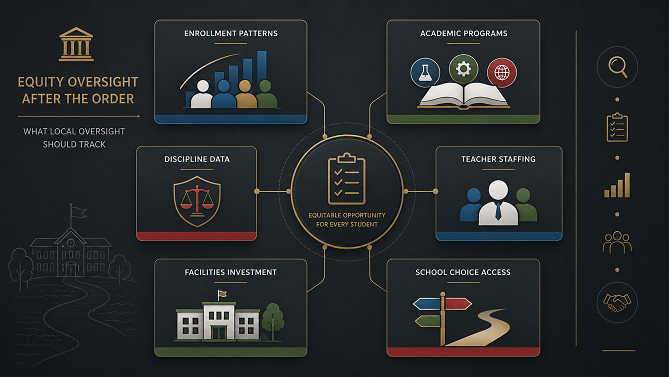
Other districts should not wait for a court fight before preparing equity evidence. If a district wants release from a desegregation order, it should be able to show public records on student assignment, staffing, transportation, facilities, extracurricular access, and academic programs. If a district is already free from such orders, it should still publish enough data for communities to evaluate opportunity.
The lesson is broader than desegregation law. School systems often move from external oversight to local discretion. That can happen after federal investigations, consent decrees, accreditation reviews, special education corrective action plans, or civil rights settlements. The transition works only when local institutions keep monitoring the conditions that prompted oversight in the first place.
Equity oversight should not depend on whether a federal judge is watching. It should be built into school board governance.
The Accountability Question After The Court File Closes
The Concordia Parish decision closes a legal chapter that began during the Civil Rights era. It does not close the educational-equity chapter. Communities still need to know whether children in Ferriday, Vidalia, and other parts of the parish have fair access to strong schools, safe learning environments, qualified teachers, advanced coursework, and well-resourced programs.
The end of a desegregation order can be framed as a return to local authority. But local authority also means local responsibility. School boards that regain full control inherit the burden of proving that equity will not disappear from the agenda once federal supervision ends.
That is the public test after 60 years of oversight. Not whether a court file remains open. Not whether state officials can declare an old mandate finished. The real test is whether local leaders can produce transparent, school-by-school evidence that opportunity is being monitored, disparities are being addressed, and communities once excluded from full educational access still have a meaningful voice in the future of their schools.