

The U.S. Department of Education’s July 10, 2026 launch of a national K-12 initiative on adult sexual misconduct in schools has pushed a difficult compliance issue into public view: school safety depends not only on written policies, but also on whether districts accurately report what happens when employees are accused of harming students. The Office for Civil Rights said it is opening 20 directed investigations into school districts whose 2023-2024 Civil Rights Data Collection submissions raised questions about whether staff-on-student sexual misconduct was being addressed appropriately.
The investigations are not findings of wrongdoing. OCR’s own pending-case guidance says inclusion on its public investigation list means the office has initiated a case, not that it has reached a decision. That distinction matters for districts named in local reporting, including the Connecticut Technical Education and Career System, DeKalb County School District in Georgia, and North East Independent School District in Texas. Still, the federal initiative signals that Title IX compliance is no longer only about whether a district has a policy on paper. It is also about whether the district’s data, internal response, staff accountability systems, and public reporting match the seriousness of the allegations.
What The Education Department Announced
The Education Department said OCR launched the national K-12 initiative to address adult sexual misconduct in schools and what the department described as a pattern of credible reports of sexual abuse or harassment by adults in authority going uninvestigated or being handled in ways that allow suspected offenders to move into new school roles. The department used the phrase “passing the trash” to describe situations in which employees accused of misconduct avoid meaningful consequences and continue working with students elsewhere.
The official Education Department announcement said the 20 directed investigations are based on 2023-2024 Civil Rights Data Collection responses that suggest districts may not be addressing staff-on-student sexual misconduct appropriately. OCR said the investigations will examine whether districts have policies and procedures to ensure accurate data collection and reporting and whether their handling of allegations of sexual harassment, including sexual assault by district employees, complies with federal law.
That puts two statutes at the center of the inquiry. Title IX prohibits sex discrimination in federally funded education programs and activities, including certain forms of sexual harassment and sexual violence. The Elementary and Secondary Education Act also matters because the department’s guidance emphasizes school responsibilities involving employee misconduct, reporting, and safeguards against moving credibly accused employees into other roles without accountability.
For families, the key point is practical. A district can have a Title IX coordinator, board policy, staff handbook, and mandatory training. But if allegations are recorded inconsistently, reported inaccurately, or not connected to employment and student-safety decisions, the system may fail before OCR ever sees the data.
Why Civil Rights Data Is Now The Evidence Trail
The Civil Rights Data Collection is a federal data system used to gather information from public schools and districts on topics such as enrollment, discipline, harassment, restraint, seclusion, school climate, and access to educational opportunity. In this initiative, OCR is focusing on data fields related to allegations and documented incidents involving school staff accused of rape, attempted rape, or sexual assault on school grounds, as well as outcomes such as whether an employee was found responsible, reassigned, resigned, retired before final discipline, found not responsible, or remained under investigation.
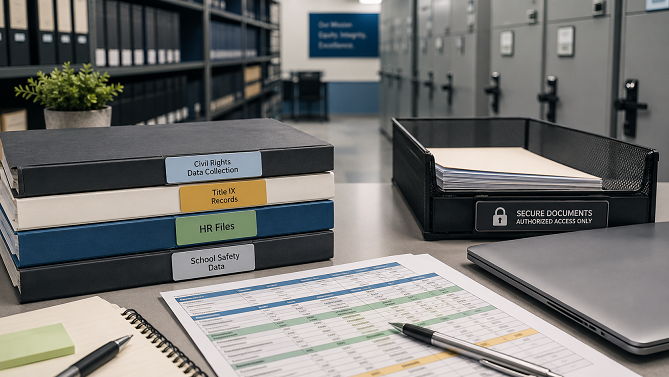
That makes data reporting more than a bureaucratic task. It becomes an evidence trail. If a district reports zero incidents while other records, complaints, lawsuits, personnel actions, or public reporting suggest otherwise, federal investigators may ask whether the district’s reporting system is broken, incomplete, or misleading.
The Parative Project’s earlier Maryland Title IX investigations analysis focused on how federal civil rights reviews can place state guidance, local policy, and student rights into conflict. The teacher misconduct initiative raises a related but distinct question: can districts prove that their internal records match what they report to the federal government?
That question is especially important in staff misconduct cases because the reporting chain is often fragmented. A student may tell a teacher. A parent may contact a principal. A counselor may create notes. Human resources may open an employee file. A school police officer may write a report. A superintendent may receive a personnel recommendation. A Title IX coordinator may or may not be looped in early. If those records do not connect, district data can understate the actual risk.
What Local Reporting Shows About The Named Districts
Local reporting has begun to identify some of the districts that received OCR letters. CT Insider reported that the Connecticut Technical Education and Career System, an independent state agency operating 17 technical high schools, is under federal investigation over whether it properly reported and responded to allegations of staff sexual misconduct involving students. The report said a July 10 letter to Superintendent Michael Crocco cited “inaccurate responses” involving rape and/or sexual assault data elements in the 2023-2024 Civil Rights Data Collection through the CTECS investigation report.
In Georgia, WABE and Decaturish reported that DeKalb County School District announced it received a federal civil rights investigation letter from OCR. The district said the review will examine its reporting of certain 2023-2024 CRDC information and whether its policies, procedures, and handling of allegations involving sexual harassment and sexual assault are consistent with Title IX requirements. Interim Superintendent Norman Sauce said the initiation of the investigation is not evidence of a violation and that OCR would conduct a neutral review, according to the DeKalb Schools report.
In Texas, the San Antonio Express-News reported that North East Independent School District is the only Texas public school district among the 20 named in the federal review. District spokesperson Aubrey Chancellor said NEISD takes allegations regarding staff sexual misconduct seriously and will provide information requested by OCR. The same reporting noted that the federal initiative will examine whether districts have procedures to accurately report sexual harassment and assault allegations and whether local policies comply with federal law through the North East ISD report.
None of these reports establishes that the districts violated federal law. They do show why data reporting has become the center of the federal review. OCR is not only asking whether misconduct occurred. It is asking whether districts had systems capable of recording, investigating, reporting, and responding to allegations when they arose.
The “Passing The Trash” Problem Is A Systems Failure
The phrase “passing the trash” is blunt, but the policy problem is specific. It describes situations where an employee accused of misconduct is allowed to resign, transfer, retire, or move to another school system without a clear accountability record following the allegation. The result can be a student-safety risk that travels across classrooms, campuses, or districts.
The Education Department’s July 10 guidance emphasized that federally funded education institutions must respond promptly and appropriately to allegations of sexual harassment, maintain policies that prevent credibly accused employees from being moved to new schools or roles to avoid accountability, and ensure students have equal access to education free from sex discrimination.
Recent reporting by KQED and ProPublica helped bring the issue back into national focus. Their investigation found that California had not revoked the credentials of at least 67 educators whose districts had determined they committed sexual harassment or other forms of sexual misconduct, and that at least 14 were rehired by other schools. The federal initiative followed that reporting and cited the broader concern that educator discipline, licensure, hiring checks, and district reporting can fail to align through the KQED-ProPublica teacher misconduct investigation.
The policy lesson is not limited to California. A district may complete an internal investigation but fail to report accurately to the state. A licensing agency may not receive complete records. A future employer may receive a neutral reference that hides the reason for separation. A school board may approve a resignation agreement without understanding how it affects future student safety. Each gap creates a route around accountability.
Why Title IX Compliance Cannot Stop At The Complaint Form
Title IX procedures often begin with a complaint form, coordinator contact, notice of rights, investigation process, and written outcome. Those pieces are important. But in staff-on-student misconduct cases, compliance has to reach deeper into district operations.
Human resources, legal counsel, school police, child protective services, campus administrators, Title IX staff, and state credentialing authorities may all touch the same case. If the Title IX office does not have access to personnel outcomes, it may not know whether the employee was reassigned. If HR does not code a resignation properly, future employers may not see the risk. If state reporting does not capture the case accurately, federal data may look clean while local records show something else.
That is why OCR’s current focus on data reporting matters. Federal civil rights enforcement depends on reliable information. Students and families also depend on it. If a district underreports staff misconduct, the public cannot evaluate whether policies are working. If a district misclassifies allegations, patterns may disappear. If outcomes are not tracked, leadership cannot tell whether accused employees are being removed, reassigned, cleared, or left in limbo.
A strong Title IX system should be able to answer basic operational questions quickly. How many staff-on-student sexual misconduct allegations were received? Who received them? Which were referred to law enforcement or child protective services? Which triggered a Title IX process? Which resulted in employment action? Which were reported to state licensing agencies? Which appeared in CRDC submissions? Where is the documentation?
If a district cannot answer those questions, the problem is not only legal. It is managerial.
What Districts Should Audit Now
Districts do not need to wait for OCR to send a letter before reviewing their systems. The July 10 initiative gives every school board and superintendent a clear checklist for internal review.
| Compliance Area | What Districts Should Check |
|---|---|
| CRDC Reporting | Whether staff misconduct data matches HR, Title IX, safety, and legal records |
| Title IX Process | Whether employee misconduct allegations are routed to the Title IX coordinator promptly |
| HR Records | Whether resignations, transfers, reassignments, and findings are coded accurately |
| Mandatory Reporting | Whether staff understand when to report to child protection or law enforcement |
| Hiring Safeguards | Whether reference checks, state registries, and credential records are reviewed |
| Board Oversight | Whether leaders receive anonymized trend data without exposing student privacy |
The most urgent review is cross-system reconciliation. A district should compare CRDC submissions against Title IX files, HR files, board personnel actions, school police referrals, insurance claims, litigation records, and state reporting documents. If the same case appears in one system but not another, leaders should find out why.
Districts should also review separation agreements. Agreements that obscure misconduct, limit disclosure, or allow an employee to quietly leave can create future student safety risks. Legal review should focus not only on avoiding litigation, but also on protecting students and preserving truthful accountability records.
Training is another weak point. Staff may understand mandatory reporting in theory but not know how it interacts with Title IX, HR investigations, and CRDC data. A teacher who hears an allegation must know where to report. A principal must know not to handle the matter informally. HR must know when an employee outcome has federal reporting implications. Data staff must know which incidents belong in CRDC fields.
What Families Should Know During These Reviews
Families should know that an OCR investigation is not proof that a district violated the law. They should also know that federal investigations exist because data and procedures matter. A school system’s response to adult misconduct should not depend on informal judgment, personal relationships, or fear of reputational harm.
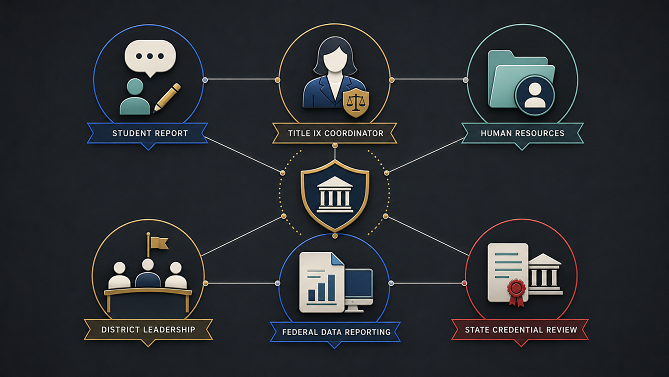
Parents and guardians should look for several public signals. Does the district identify its Title IX coordinator? Does it explain how students and families can report staff misconduct? Does it prohibit retaliation? Does it explain when law enforcement or child protective services may be involved? Does it train staff annually? Does the board receive safety and compliance updates? Does the district describe how it prevents accused employees from being quietly moved into other student-facing roles?
Students should also receive age-appropriate information. They need to know which adults they can tell, that retaliation is prohibited, that they are not responsible for protecting a school’s reputation, and that adults in authority have reporting duties. Policies written only for lawyers do little for a student who needs help on a school day.
Districts should communicate carefully. They should not publish confidential student or personnel details. They should not minimize federal review. They should not describe an open investigation as a final finding. The best public message is specific and measured: here is what OCR is reviewing, here is what remains confidential, here is how students can report concerns, here is how the district protects students while cooperating with investigators.
Why Data Transparency Is A Student Safety Issue
Data transparency is often discussed as an administrative burden. In this context, it is a student safety issue. Accurate reporting helps identify whether misconduct allegations are isolated, recurring, mishandled, or hidden across different departments. It helps state and federal agencies decide where oversight is needed. It helps school boards ask better questions. It helps families understand whether a district has a functioning response system.
The danger is that zero can be misleading. A district reporting no staff-on-student sexual misconduct may truly have had no reportable incidents. Or it may have reporting gaps, classification problems, inconsistent documentation, or unresolved confusion about which allegations count. OCR’s initiative is effectively asking districts to prove that their numbers mean what they appear to mean.
That does not mean districts should inflate numbers or treat every rumor as a substantiated case. It means they need clean categories: allegation, report, investigation, finding, employment outcome, law enforcement referral, state licensing report, and federal data submission. Each category should be documented accurately.
The student-rights question is simple. If schools cannot count and report allegations accurately, can students trust the system to respond when an adult is accused of harm?
The Larger Accountability Test
The federal teacher misconduct probes put Title IX data reporting under the microscope because the safety system depends on the integrity of the records. A complaint that disappears from the data trail can become a future risk. A resignation that hides a finding can become another district’s hiring problem. A federal report that understates incidents can make oversight weaker than it should be.
The Education Department’s initiative may become controversial because it comes amid broader shifts in federal civil rights enforcement. That debate should not obscure the core institutional issue. Students need schools where adults accused of serious misconduct are investigated properly, records are handled accurately, and employment decisions do not place future students at risk.
For districts, the lesson is immediate. Title IX compliance is not complete because a policy exists online. It must be visible in data systems, personnel files, training records, reporting forms, board oversight, and student-facing support. The federal investigations will determine whether the 20 named districts met their obligations. Every other district should treat the moment as a warning to test its own system before OCR, parents, or harmed students have to do it for them.