

The U.S. Department of Education’s July 23, 2026 decision to remove disparate-impact provisions from its Title VI regulations has shifted one of the most contested questions in school civil rights enforcement back to local districts: what should public schools do when neutral discipline policies produce sharply unequal outcomes by race, disability, language status, or other student characteristics?
The department says the rollback restores Title VI to an intent-focused civil rights framework and prevents federal officials from treating demographic imbalance alone as proof of discrimination. Civil rights advocates warn that the change weakens a long-used tool for identifying systemic discrimination when no official policy says the quiet part out loud. For school districts, the practical message is clear: federal enforcement may be narrowing, but discipline data is not becoming less important. It may become more important because local boards, state agencies, families, journalists, and community advocates will now have to scrutinize disparities with fewer federal disparate-impact tools behind them.
What The Education Department Changed
The Education Department’s Office for Civil Rights announced on July 23, 2026 that it was rescinding several disparate-impact provisions from regulations implementing Title VI of the Civil Rights Act of 1964. Title VI prohibits discrimination based on race, color, or national origin in programs receiving federal financial assistance. The department’s Title VI disparate-impact announcement described the action as a deregulatory step aligned with Executive Order 14281, “Restoring Equality of Opportunity and Meritocracy.”
The final rule published in the Federal Register says the department is amending 34 CFR Part 100 to eliminate disparate-impact liability. The department argues the change aligns its regulations with Title VI’s original meaning, avoids constitutional concerns, lowers compliance costs, and reduces confusion for schools and other recipients of federal funds.
That is the administration’s legal theory. The policy effect is more concrete. OCR will no longer use the rescinded Title VI regulatory provisions to pursue claims based on a facially neutral policy’s unequal effects alone. Intentional discrimination remains prohibited. Schools still cannot intentionally discriminate on the basis of race, color, or national origin. But the evidentiary path changes when the problem is not an explicitly discriminatory rule, but a discipline system that produces unequal results.
AP reported that the Education Department will no longer consider school policies that disproportionately harm one student group discriminatory unless intentional discrimination is shown. K-12 Dive reported that the department issued the final rule without seeking public comment beforehand. That procedural choice will likely become part of the debate because the rule affects a decades-old civil rights enforcement framework.
Why School Discipline Is The Immediate Flashpoint
Disparate-impact enforcement has mattered in education because many school policies are written in neutral language. A discipline code may say students can be suspended for disruption, defiance, disorderly conduct, or repeated rule violations. On paper, the rule applies to everyone. In practice, the question is whether the rule is applied evenly, whether staff discretion produces unequal outcomes, whether some categories are too vague, and whether schools have less discriminatory alternatives that still maintain safety.

School discipline is where those questions become visible. The Department of Education’s Civil Rights Data Collection has long tracked suspensions, expulsions, referrals to law enforcement, school-related arrests, restraint, seclusion, bullying, harassment, access to programs, staffing, and other school-climate factors. The department says the CRDC has collected civil rights data since 1968 and that most CRDC data are disaggregated by race, ethnicity, sex, disability, and English learner status through the Civil Rights Data Collection.
The department’s own school climate and discipline resources state that CRDC and IDEA data have consistently shown that student discipline disproportionately involves students of color, particularly Black students, and students with disabilities. That does not automatically prove unlawful discrimination in every district. It does prove that the data cannot be ignored.
The rollback changes what federal OCR may emphasize, but it does not make disparities disappear. A school board that sees Black students suspended at much higher rates than white students, students with disabilities removed from class more often than peers, or English learners referred for discipline after language-related misunderstandings still has a governance problem to examine. The question is whether the response will now be driven mainly by local accountability instead of federal disparate-impact enforcement.
The Difference Between Data And Proof
One risk in the public debate is oversimplification. Discipline data is not proof by itself that a school district intentionally discriminated. It is also not meaningless.
Data is a starting point. If one group of students is suspended, expelled, restrained, or referred to law enforcement at a much higher rate than another group, local leaders should ask why. The answer may involve student need, staff training, inconsistent school-level practices, vague discipline categories, implicit bias, resource gaps, disability supports, classroom management, school climate, or real differences in incident patterns. The point of data review is to find out, not to assume the answer.
The old disparate-impact framework gave federal civil rights officials a way to ask whether a neutral policy produced unjustified unequal effects and whether a less discriminatory alternative existed. The new federal approach narrows that path under Title VI. But districts should not confuse a narrower federal standard with permission to stop asking the underlying questions.
That distinction connects directly to The Parative Project’s recent federal teacher misconduct probes analysis. In both contexts, school data is not just paperwork. It is the evidence trail that shows whether a system is functioning. In staff misconduct cases, data shows whether reports move through Title IX, HR, and federal reporting systems. In discipline cases, data shows whether rules are being applied consistently and whether some students experience school as more punitive than supportive.
The legal standard may shift. The governance duty remains.
What Local Districts Should Audit Now
Districts should not wait for a federal complaint to examine discipline patterns. The rollback makes local audits more important because fewer federal disparate-impact investigations may mean fewer outside prompts to identify unequal outcomes.
A responsible district review should begin with current discipline data and then move into practice. Leaders should compare suspension, expulsion, restraint, seclusion, law enforcement referral, and alternative placement data across schools and student groups. They should examine categories such as defiance, disruption, disrespect, dress code, physical aggression, threats, attendance-related discipline, and technology misuse. They should ask whether some categories give staff too much discretion without enough guidance.
| Discipline Area | Local Equity Question To Ask |
|---|---|
| Suspensions | Which student groups are removed from class most often, and for what reasons? |
| Expulsions | Are severe consequences concentrated by race, disability, school, or grade level? |
| Referrals To Law Enforcement | Which incidents become police matters, and who makes that decision? |
| Restraint And Seclusion | Are students with disabilities affected at disproportionate rates? |
| Vague Offenses | Do categories like disruption or defiance produce inconsistent outcomes? |
| School-Level Differences | Do similar incidents lead to different consequences at different campuses? |
The audit should not stop with numbers. Districts should review discipline codes, principal discretion, staff training, restorative practices, special education manifestation determination procedures, threat-assessment protocols, school resource officer agreements, and family communication practices. If data shows a disparity, leaders should ask whether policy design, staff judgment, student supports, or school climate is contributing to it.
The best audits include public reporting. Families should not have to file open-records requests to learn whether discipline is equitable across schools.
Why State Agencies May Become More Important
With federal disparate-impact enforcement narrowed, state education agencies may become more important in discipline oversight. Some states already require school climate reporting, discipline dashboards, suspension limits, restorative-practice guidance, or special education discipline monitoring. Others leave most discipline review to local districts.
The Title VI rollback does not prevent states from asking districts to examine disparities. It does not prevent state boards from setting discipline data standards. It does not prevent state civil rights agencies from enforcing state law where applicable. It also does not prevent state legislatures from requiring transparency around exclusionary discipline.
That matters because discipline is not only a civil rights issue. It is an academic access issue. A student who is repeatedly suspended loses instructional time. A student sent to alternative placement may lose access to advanced courses, extracurriculars, peer relationships, and specialized supports. A student referred to law enforcement may experience consequences that reach beyond school.
State leaders should therefore treat discipline data as part of school quality. Chronic absenteeism, literacy, math achievement, graduation rates, and college readiness are all affected by whether students remain connected to school. If discipline data is ignored, academic accountability is incomplete.
What Families And Communities Should Watch
Families and community organizations should watch for changes in how districts discuss discipline after the federal rollback. Some districts may treat the rule change as a signal that they no longer need to review racial disparities unless intentional discrimination is alleged. That would be a mistake. Public trust depends on whether districts can explain outcomes, not only whether they can survive a federal legal test.
Parents should look for several signals. Does the district publish discipline data by school and student group? Does it explain what offenses lead to suspension or expulsion? Does it track students with disabilities separately where required? Does it report law enforcement referrals? Does it compare schools with similar demographics? Does it train staff on consistent discipline? Does it offer alternatives that keep students learning while maintaining safety?
Community groups should also ask how districts respond to disparities. A district should not set racial quotas for discipline outcomes. It should examine whether similarly situated students are being treated similarly, whether policies are too vague, whether supports are available before behavior escalates, and whether staff receive the training needed to manage classrooms fairly.
Civil rights enforcement is not the only reason to ask those questions. Good governance requires them.
The Safety Argument Needs Better Data Too
Supporters of the rollback argue that schools need freedom to maintain order without federal pressure to balance outcomes by race. That argument should not be dismissed. Teachers and principals need authority to respond to serious misconduct, protect students, and maintain safe classrooms. A discipline system that only tries to reduce numbers without addressing behavior can fail students and staff.
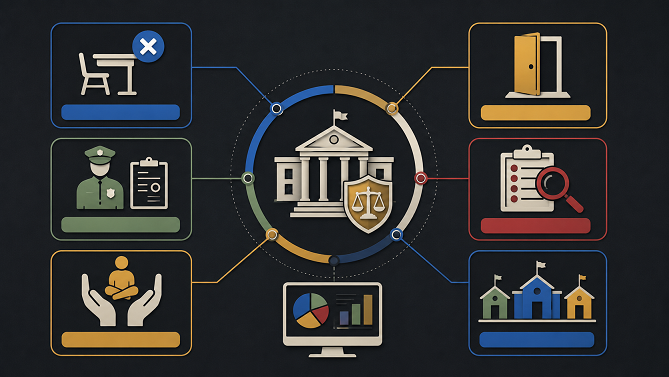
But the safety argument also requires data. If a district says suspensions are necessary for school safety, it should show whether suspensions reduce repeat incidents, improve classroom climate, or produce better outcomes than alternatives. If a district uses law enforcement referrals, it should show which incidents are referred and why. If a district relies on exclusionary discipline, it should know whether the same students cycle repeatedly through removal without receiving effective support.
Data can protect safety and equity at the same time. It can show where staff need support. It can identify campuses with recurring problems. It can reveal whether restorative programs are working or merely reducing formal suspensions. It can show whether students with disabilities are being disciplined for behavior related to unmet needs. It can help districts distinguish serious threats from ordinary adolescent conflict.
The rollback may reduce one form of federal scrutiny, but it should not reduce the quality of local analysis.
How Districts Can Build A Stronger Local Standard
Districts should respond to the new federal environment by creating their own discipline equity standard. That standard does not have to mirror the rescinded federal disparate-impact rule. It should be practical, transparent, and connected to student safety.
A strong local standard would include annual discipline dashboards, school-level reviews, clear definitions for subjective offenses, principal training, due process protections, special education compliance checks, family notice procedures, and board review of major disparities. It should also include a process for testing alternatives before relying on exclusion.
For example, if one middle school suspends students for disruption at twice the rate of another school with similar enrollment, district leaders should investigate. If Black students are much more likely to receive out-of-school suspension for subjective offenses, the district should review staff discretion and incident documentation. If students with disabilities are disproportionately restrained or secluded, special education leaders should examine behavior plans, staffing, and compliance with federal and state law.
The point is not to assume discrimination in every disparity. The point is to make disparities explainable, documented, and addressed.
The Larger Civil Rights Question
The Title VI disparate-impact rollback arrives during a broader shift in federal civil rights policy. Executive Order 14281 instructed federal agencies to move away from disparate-impact liability to the maximum degree possible. The Education Department’s final rule now applies that direction to Title VI education regulations. Supporters see the change as restoring equal treatment under the law. Critics see it as removing one of the few tools capable of addressing systemic discrimination when intent is difficult to prove.
For public schools, the debate will become concrete in discipline data. Students and families will not experience the rollback as a law-review argument. They will experience it through suspension letters, discipline hearings, alternative placements, missed class time, school climate, and whether adults listen when patterns appear unfair.
That is why local transparency matters now. If federal OCR is less likely to use disparate-impact analysis, districts should be more willing to publish and explain their own discipline outcomes. If the federal government says demographic data alone should not establish a violation, local boards should still recognize that demographic data can reveal a problem worth solving.
Civil rights enforcement may be changing, but the public question remains the same: are schools giving students equal access to learning, safety, and fair treatment? The answer will not be found only in federal regulations. It will be found in the discipline data districts collect, the patterns they are willing to confront, and the local accountability systems they build when Washington steps back.